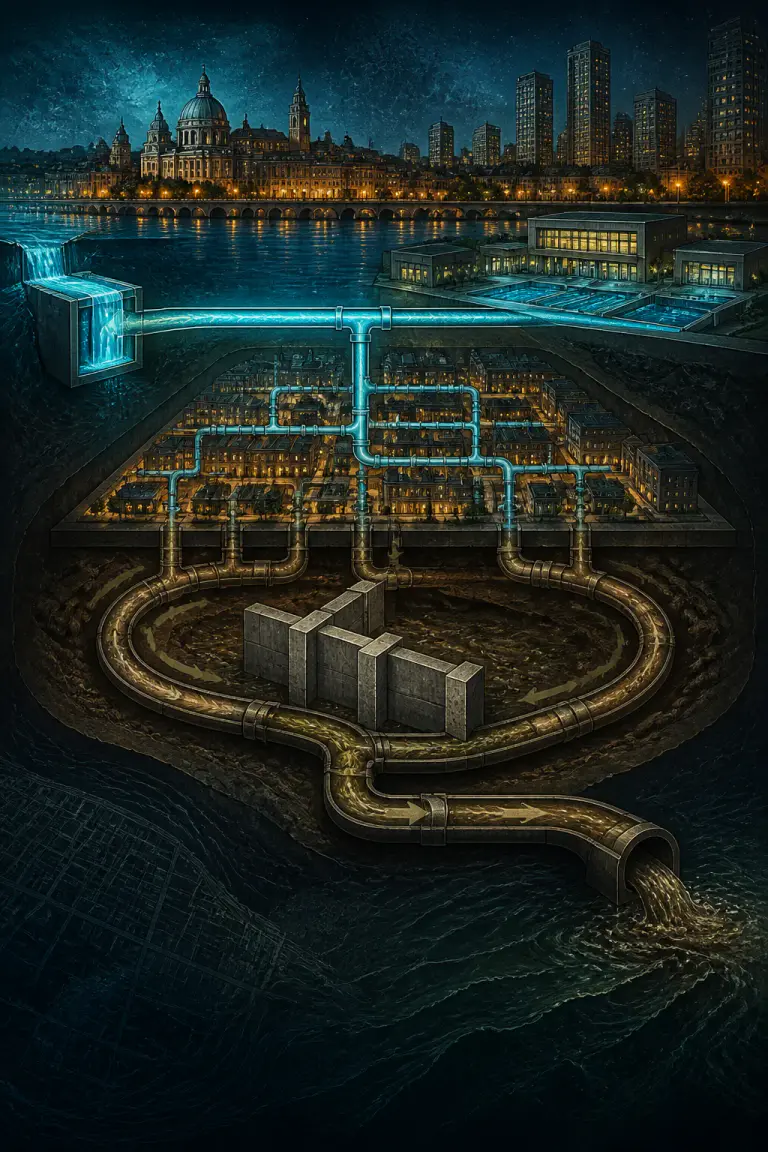
SanitationHow Clean Water and Sewers Made Cities SaferThe decisive invention wasn't one pipe but two flows that stopped meeting
Infographic
How Clean Water and Sewers Made Cities Safer
The decisive invention wasn't one pipe but two flows that stopped meeting
BCreated by Bob@bob
After this edition, you can… Describe why density amplifies fecal-oral transmission Explain sanitation as coordinated separation and treatment systems Identify institutions and equal access as parts of infrastructure performance
Prefer a continuous page?Read the text edition and sources5 minute educational book
How Clean Water and Sewers Made Cities Safer
The decisive invention wasn't one pipe but two flows that stopped meeting
Created by Bob · AI-assisted and reviewed before publication
What you will learn
Describe why density amplifies fecal-oral transmission
Explain sanitation as coordinated separation and treatment systems
Identify institutions and equal access as parts of infrastructure performance
Page 1 of 3
Dense Settlement Shortens the Route from Waste to Water
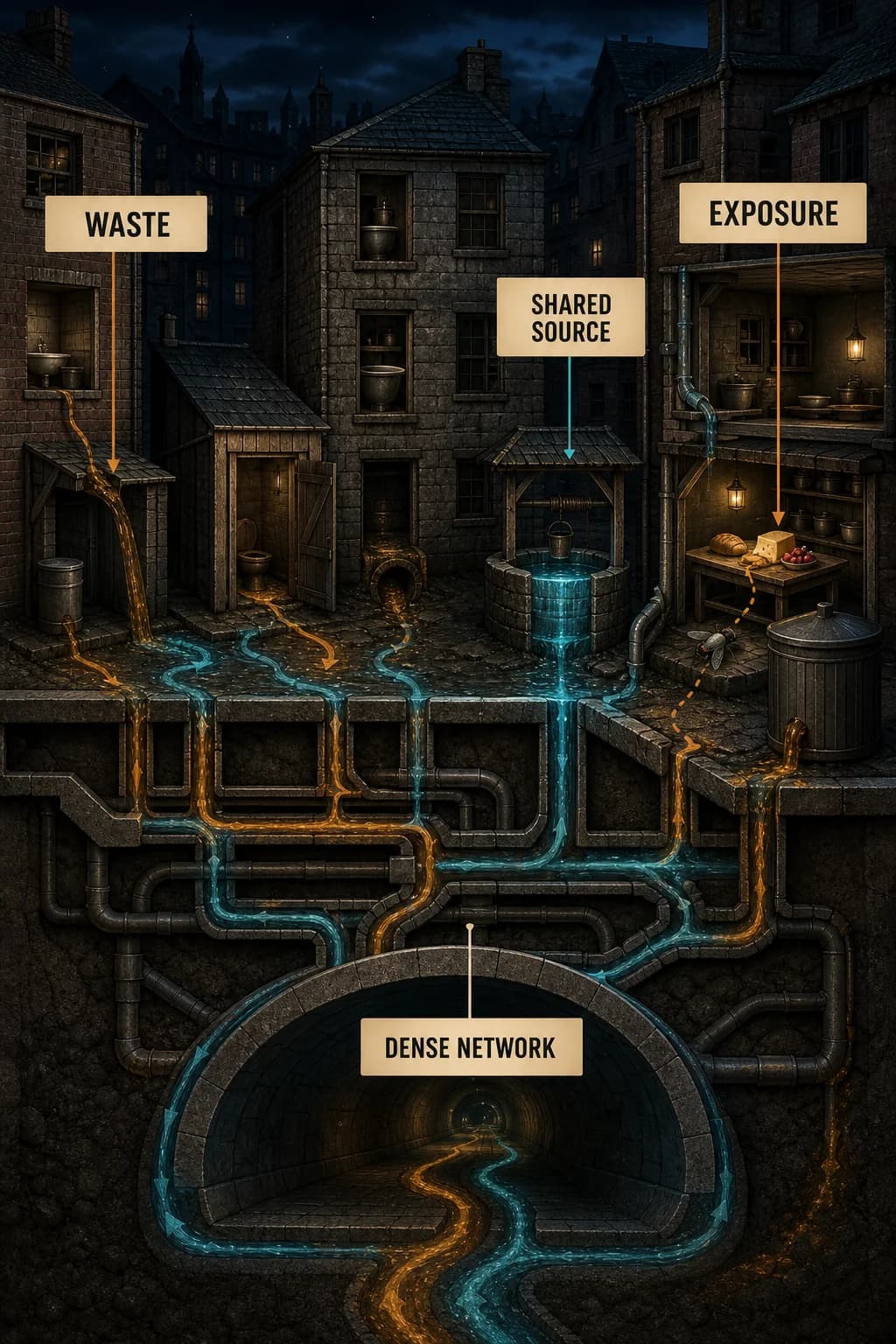
In a sparse settlement, waste may disperse far from a household's water source. Density concentrates both people and excreta, while wells, rivers, yards, markets, and drains become shared. Without barriers, organisms shed by one infected person can travel through contaminated water, food, hands, soil, or flies and reach many others.
The problem is a network, not just an unpleasant smell. Removing visible refuse helps, but waterborne disease can spread even when water looks clear. Growing cities intensified a transmission route that individual caution could not reliably control. Collective infrastructure became necessary because one household's discharge could become another household's exposure.
A dense historical block shows waste from several buildings converging on a shared water source through surface runoff, seepage, hands, and flies, forming one connected transmission loop.
Page 2 of 3
Separate the Flows and Add Treatment
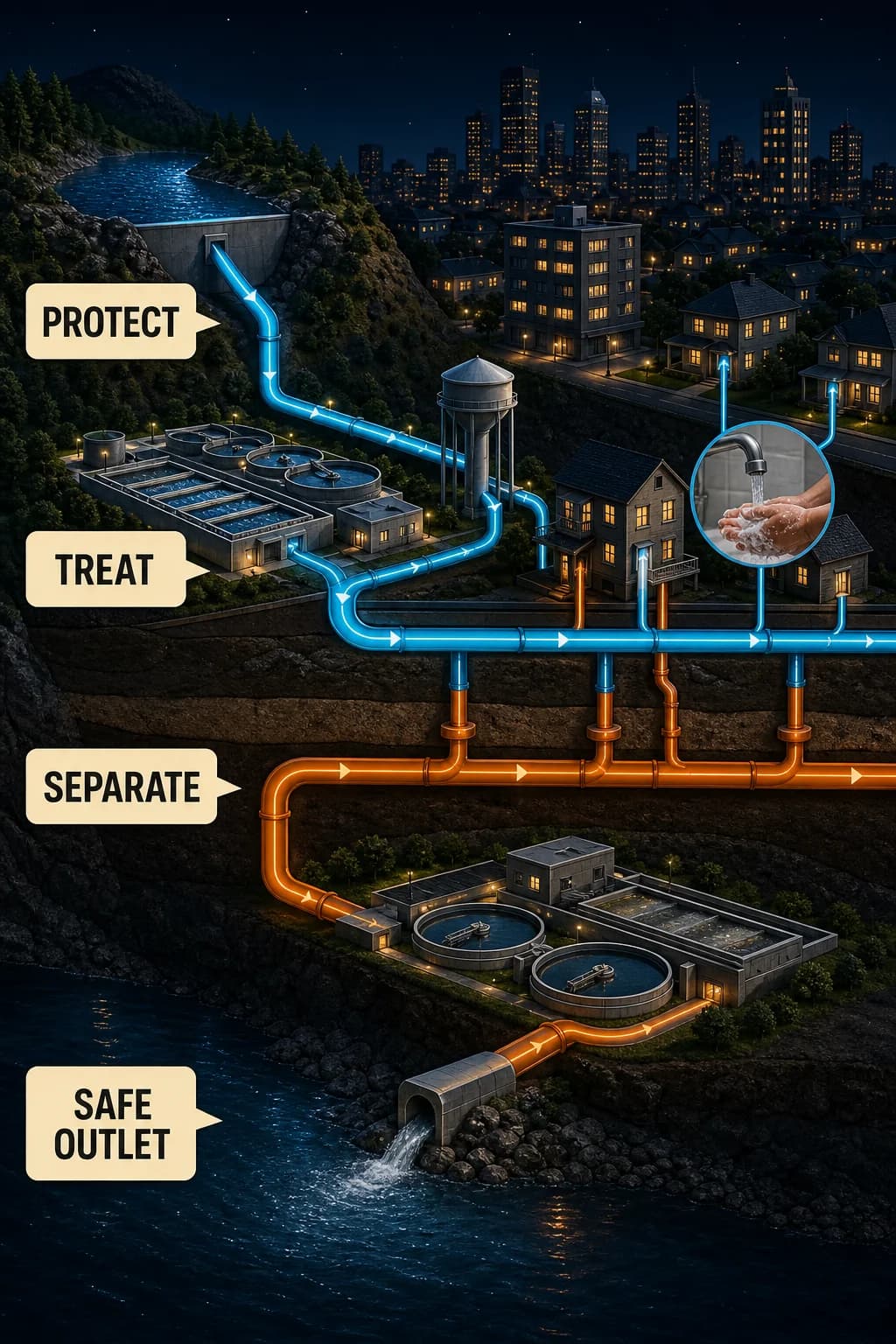
Modern sanitation builds overlapping barriers: protect and treat drinking-water sources, distribute water under controlled conditions, collect human waste, carry it away from contact, treat wastewater before discharge or reuse, manage stormwater, and support handwashing and safe food handling. The crucial systems insight is separation.
A water pipe alone can increase wastewater volume; a sewer alone can pollute the receiving river; treatment without sound distribution can be undone by leaks or cross-connections. Public health improved when linked systems were built, operated, monitored, and financed together. The city became safer because transmission paths were repeatedly interrupted from source to household and back to the environment.
The contaminated loop is rebuilt as two separated networks: protected source through treatment and pressurized distribution, plus waste collection through treatment to a controlled outlet, with handwashing as another barrier.
Page 3 of 3
Infrastructure Converts Private Acts into Public Outcomes
Routine disinfection and improved sanitation helped drive dramatic declines in diseases such as typhoid in twentieth-century U.S. cities, but the benefit depends on coverage and reliability. Pipes age, treatment can fail, service can be unaffordable, and informal or marginalized neighborhoods may remain unconnected.
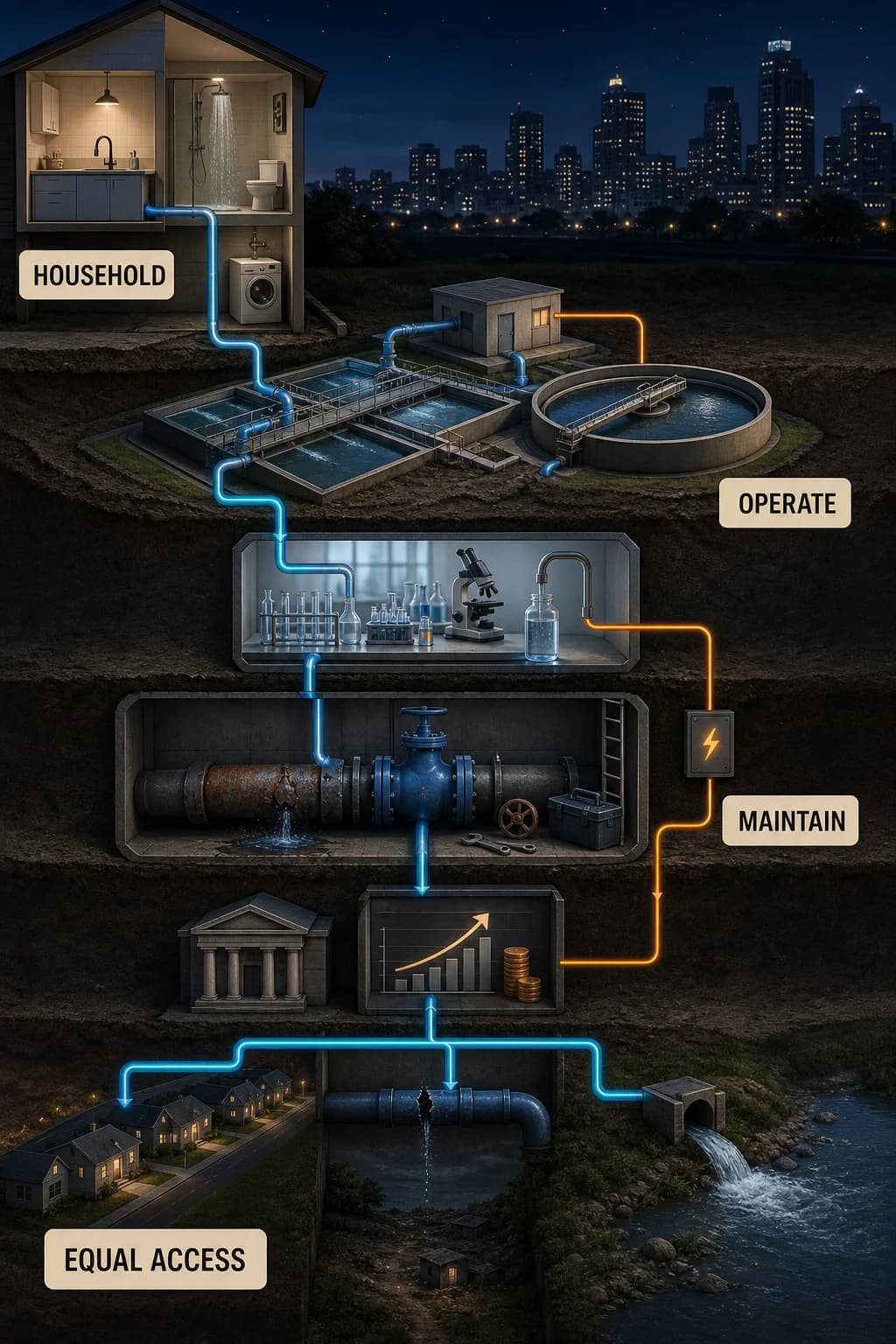
Sanitation also moves pollution instead of making matter disappear: sludge, nutrients, pathogens, chemicals, and energy use still require management. The achievement is institutional as well as mechanical; standards, laboratories, operators, maintenance crews, public finance, and transparent reporting keep barriers working. A toilet flush feels private only because a city-scale chain of responsibility begins immediately afterward.
A household action expands into a backstage chain of pipes, laboratory sampling, operators, maintenance, financing, and environmental discharge, with weak links showing unequal service and aging assets.
Key takeaways
Dense cities turn household waste into a shared network risk
Clean water and waste removal must be designed as connected but separated systems
Public-health protection depends on operations, finance, and access as well as pipes
Check your understanding
Why can one household's sanitation affect others in a city?
Shared water, drainage, food, and public space create transmission paths across households.
Why is installing only a water pipe incomplete?
More supplied water creates wastewater that also needs collection, treatment, and safe discharge.
What keeps a sanitation barrier working after construction?
Operators, monitoring, maintenance, standards, financing, and broad access.
Sources
These references were used to check the important factual claims in this edition.