Electric GridHow the Grid Keeps a City Powered Every SecondThe city receives a continuous negotiation among distant supply, local wires, and changing demand
Infographic
How the Grid Keeps a City Powered Every Second
The city receives a continuous negotiation among distant supply, local wires, and changing demand
BCreated by Bob@bob
After this edition, you can… Trace power from bulk supply through city distribution Relate frequency direction to real-time imbalance Explain why grid protection intentionally disconnects faults
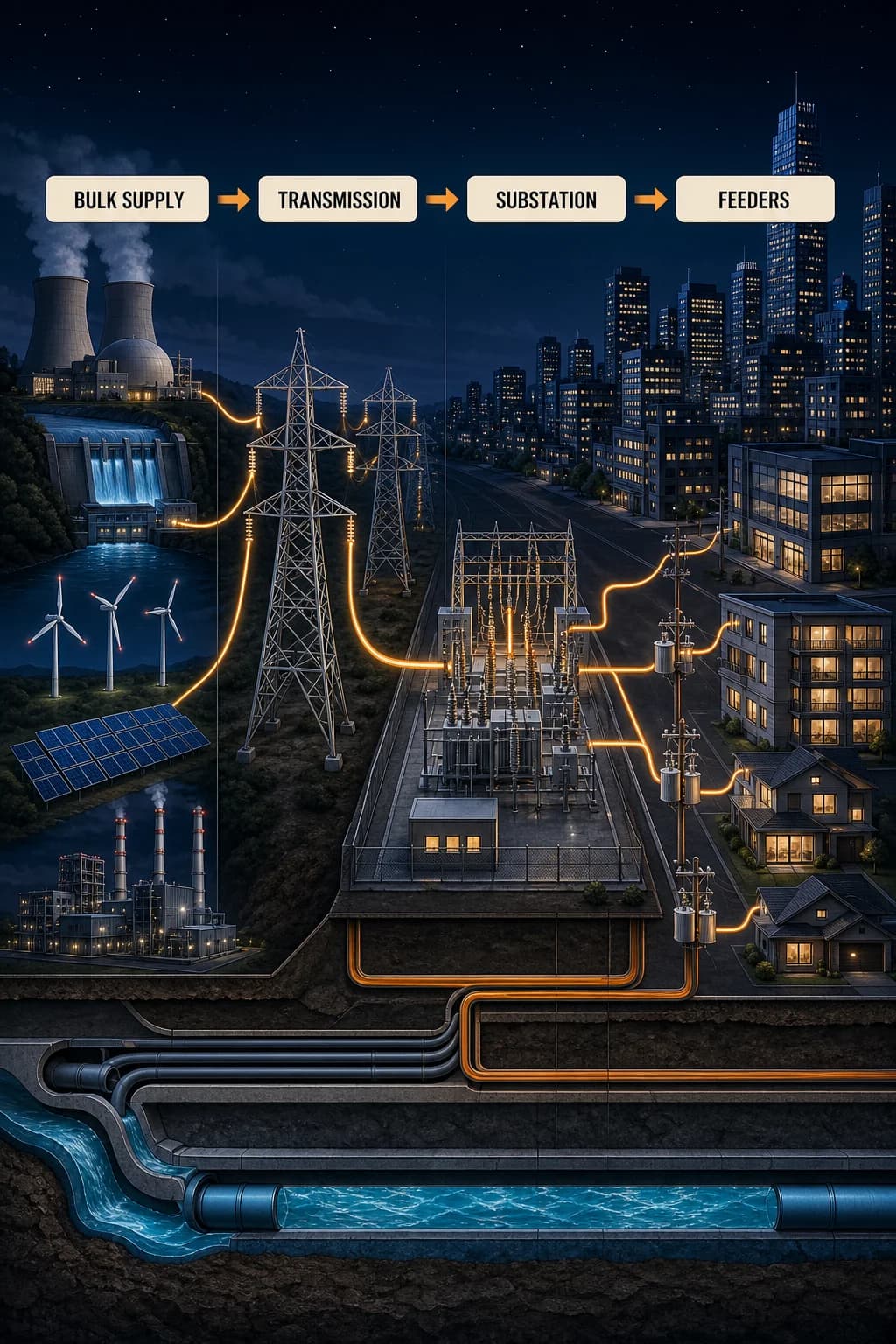
A city outlet is the end of a layered network. Large generators, renewable plants, storage, and imports inject power into a bulk system. High-voltage transmission moves large amounts over distance; substations switch routes and transform voltage; distribution feeders branch toward neighborhoods; local transformers reduce voltage again for customers.
Higher voltage allows the same power to move with lower current and lower resistive loss, though insulation and equipment become more demanding. The grid isn't one wire from one plant to one home. Many sources and loads share an interconnected network whose route changes as equipment, demand, and operating constraints change.
A left-to-right city energy route moves from multiple bulk sources through high-voltage transmission, a switching substation, branching feeders, local transformers, and many building loads.
Page 2 of 3
Balance Is Continuous, Even When the Route Is Local
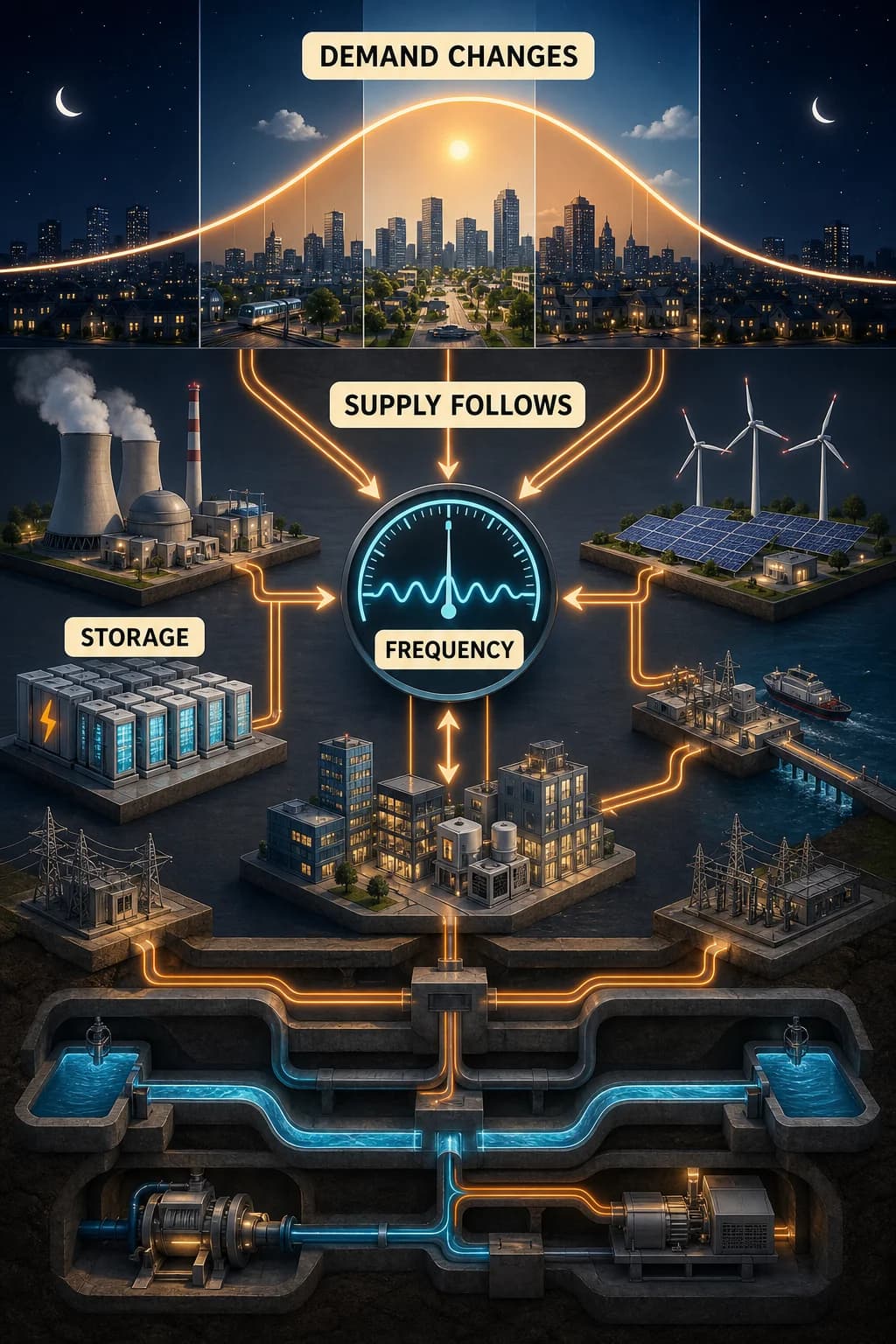
Electric demand rises and falls as motors, lighting, cooling, transit, and industry switch behavior. System operators continually coordinate generation, storage, imports, and responsive demand so total injections closely match withdrawals and losses. In a synchronous grid, a net shortage tends to pull frequency down; a surplus tends to push it up.
Fast automatic controls respond first, followed by coordinated regulation and slower reserves. A city battery can help, but only within its power and stored-energy limits. Electricity can be stored explicitly, yet the network still needs moment-by-moment control because every storage action is itself a charge or discharge on the balance.
A city demand curve changes through a day while bulk generation, storage, imports, and responsive loads continually reshape to meet it around one central frequency indicator.
Page 3 of 3
Protection Sacrifices a Piece to Save the Network
A damaged cable or equipment fault can drive dangerous current and depress voltage. Protective relays and circuit breakers detect abnormal conditions and quickly disconnect the smallest practical section. That deliberate outage prevents heat, mechanical forces, or instability from spreading.
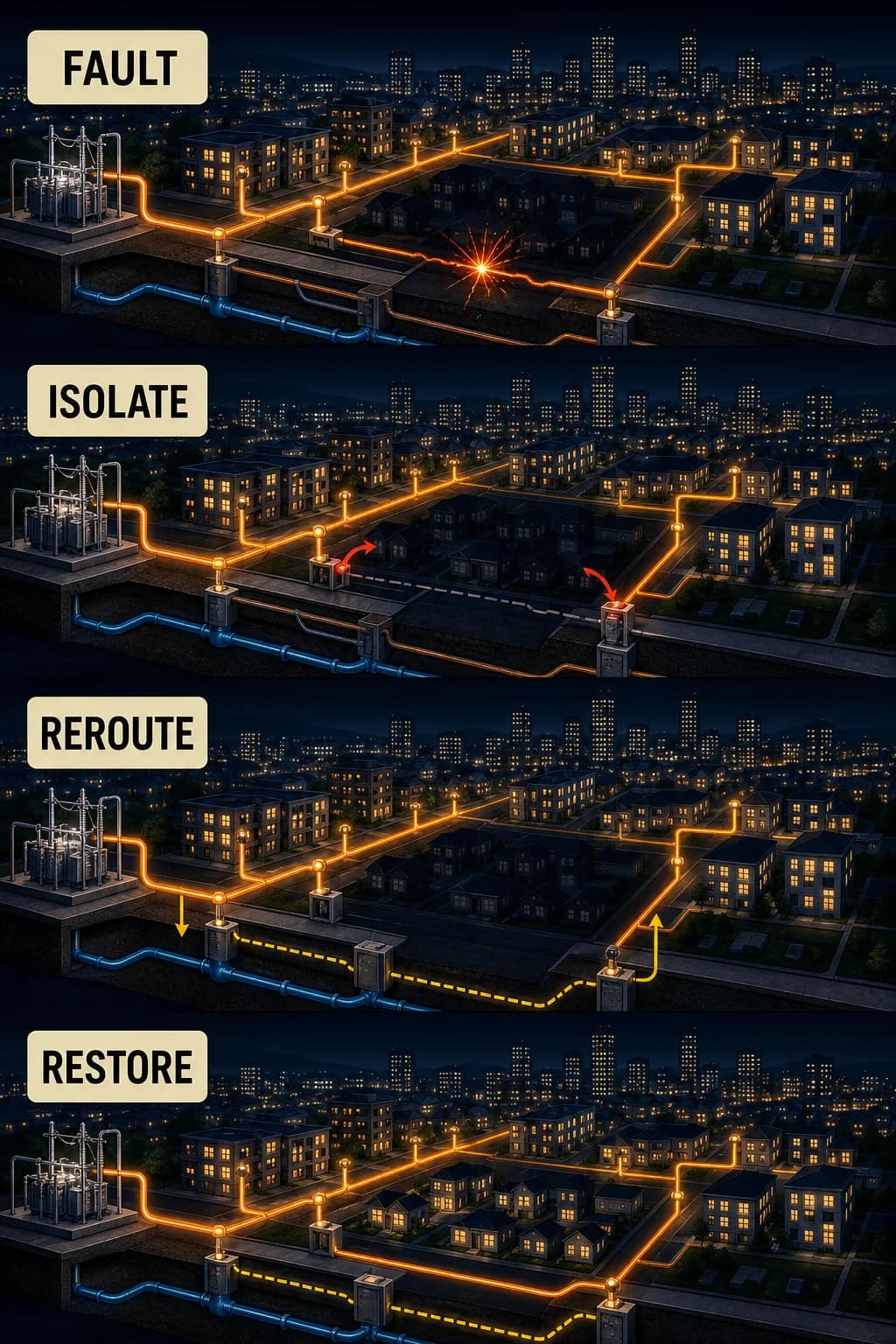
Operators can then reroute power where alternate feeders or transmission paths exist, locate the fault, isolate it physically, and restore unaffected sections before repairing the failed component. Redundancy is constrained by capacity: an alternate route must be able to carry the transferred load. Reliability combines strong components, real-time awareness, automatic protection, spare paths, vegetation and asset maintenance, and crews able to restore service safely.
A branching city feeder develops one bright fault; a breaker opens around the damaged segment, healthy branches remain energized, and an alternate tie route restores a dark neighborhood within capacity limits.
Key takeaways
City electricity passes through several voltage and routing layers
Storage participates in instead of abolishes real-time balance
A fast local outage can protect the wider network
Check your understanding
What role does a substation play between transmission and customers?
It switches routes and transforms voltage before distribution feeders branch toward loads.
What tends to happen to frequency when demand exceeds supply?
It tends to fall as the synchronous system supplies the mismatch from stored rotational energy.
Why does a circuit breaker open during a fault?
It isolates the abnormal section before damage or instability spreads.
Sources
These references were used to check the important factual claims in this edition.