SewersHow Sewers Use Gravity to Cross a CityThe cheapest mover is a carefully maintained downhill path; until terrain forces a lift
Infographic
How Sewers Use Gravity to Cross a City
The cheapest mover is a carefully maintained downhill path; until terrain forces a lift
BCreated by Bob@bob
After this edition, you can… Trace wastewater through a branching gravity collection network Explain when a lift station and force main are needed Identify infiltration, inflow, and blockages as capacity threats
Prefer a continuous page?Read the text edition and sources5 minute educational book
How Sewers Use Gravity to Cross a City
The cheapest mover is a carefully maintained downhill path; until terrain forces a lift
Created by Bob · AI-assisted and reviewed before publication
What you will learn
Trace wastewater through a branching gravity collection network
Explain when a lift station and force main are needed
Identify infiltration, inflow, and blockages as capacity threats
Page 1 of 3
Every Branch Spends Elevation
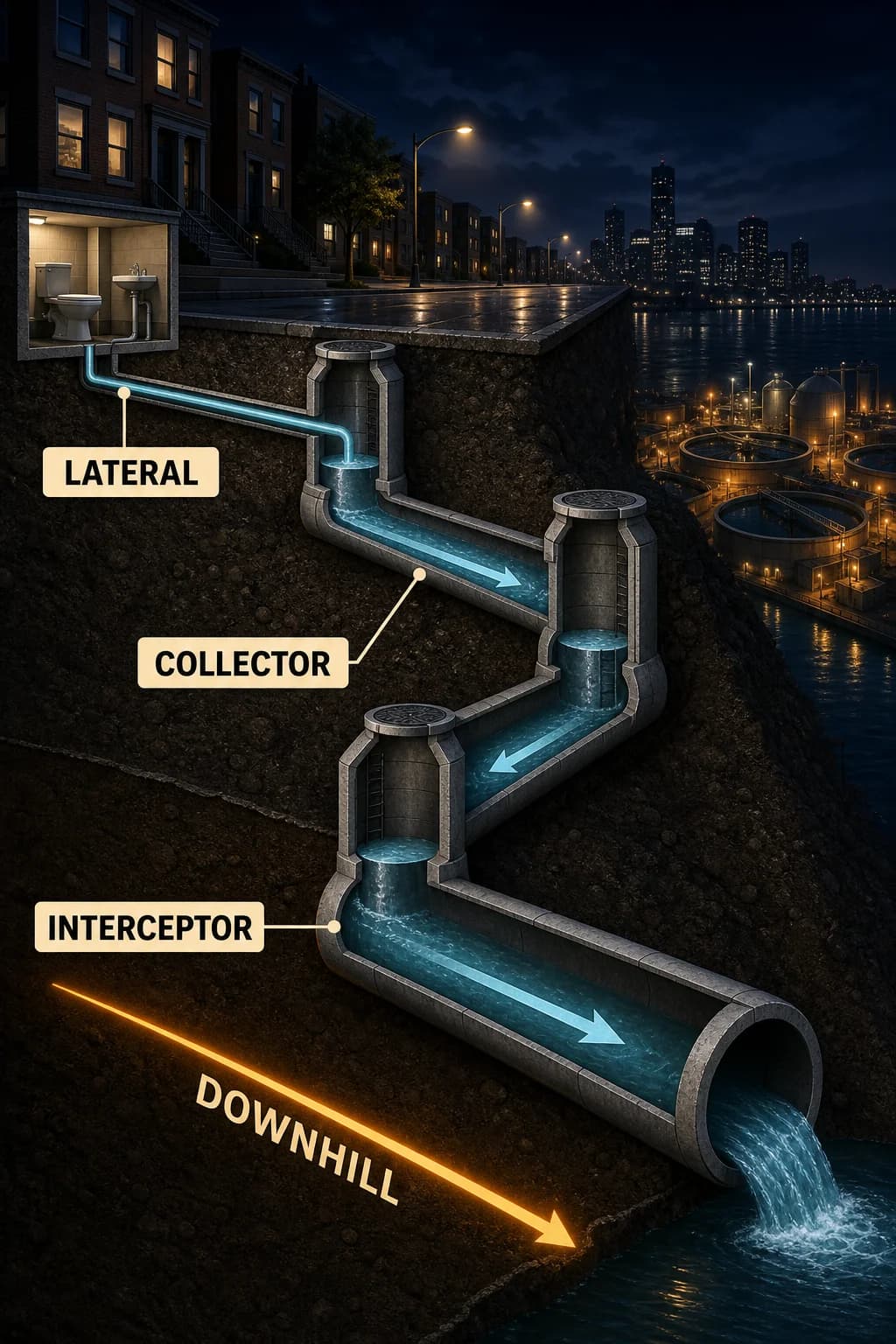
A conventional gravity sewer carries wastewater through pipes laid on a downward gradient. Small building connections join local collectors; collectors merge into larger interceptors that lead toward treatment. The network must be deep enough to receive upstream flows yet not so deep that excavation becomes impractical.
Pipe diameter and slope are chosen to carry expected flow while limiting sediment deposition and avoiding unwanted pressurization. Manholes provide access where lines join or change direction, but they also mark points that must be sealed and maintained. Gravity supplies the motive force; careful surveying turns the city's elevation into a transportation budget.
A street-to-treatment cross-section shows building laterals joining successively larger sloped collectors and an interceptor, with elevation steadily descending and manholes at junctions.
Page 2 of 3
A Lift Station Resets the Elevation Budget
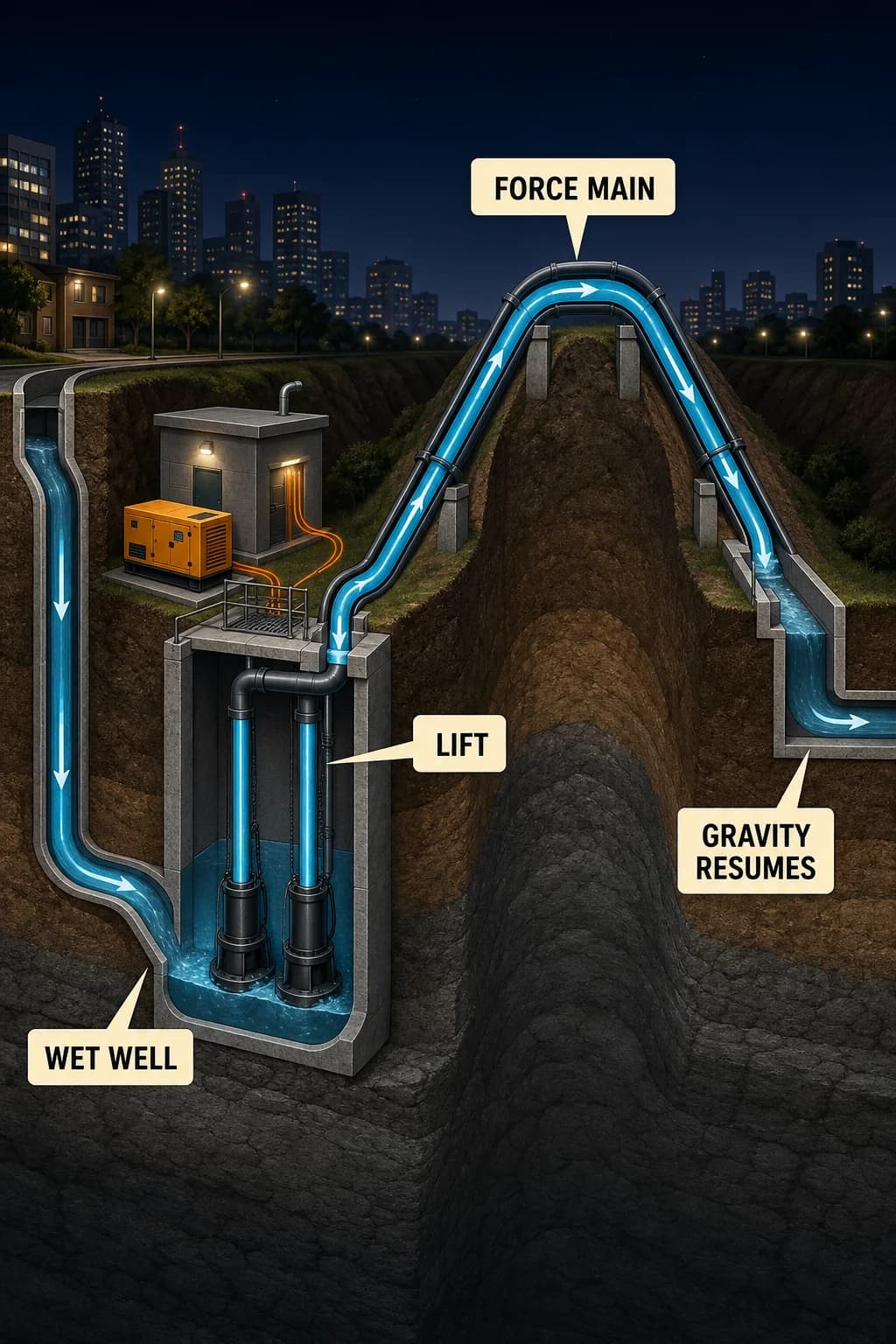
Terrain doesn't always descend toward the treatment plant. At a low point, wastewater can collect in a wet well and pumps can push it through a pressurized force main to a higher elevation. From there, gravity flow may resume. This avoids burying the entire downstream sewer ever deeper, but it exchanges excavation for machinery, controls, maintenance, and electricity.
Pumps must handle variable inflow and abrasive or clogging material. Redundant pumps, alarms, emergency power, and bypass plans matter because a failed lift station can cause upstream backups or overflows. The gravity network is punctuated by powered resets wherever topography wins.
A descending gravity pipe reaches a wet well, two pumps raise flow through a force main over a ridge, and a new gravity segment resumes on the far side; backup power sits beside the station.
Page 3 of 3
Rain and Groundwater Can Steal Capacity
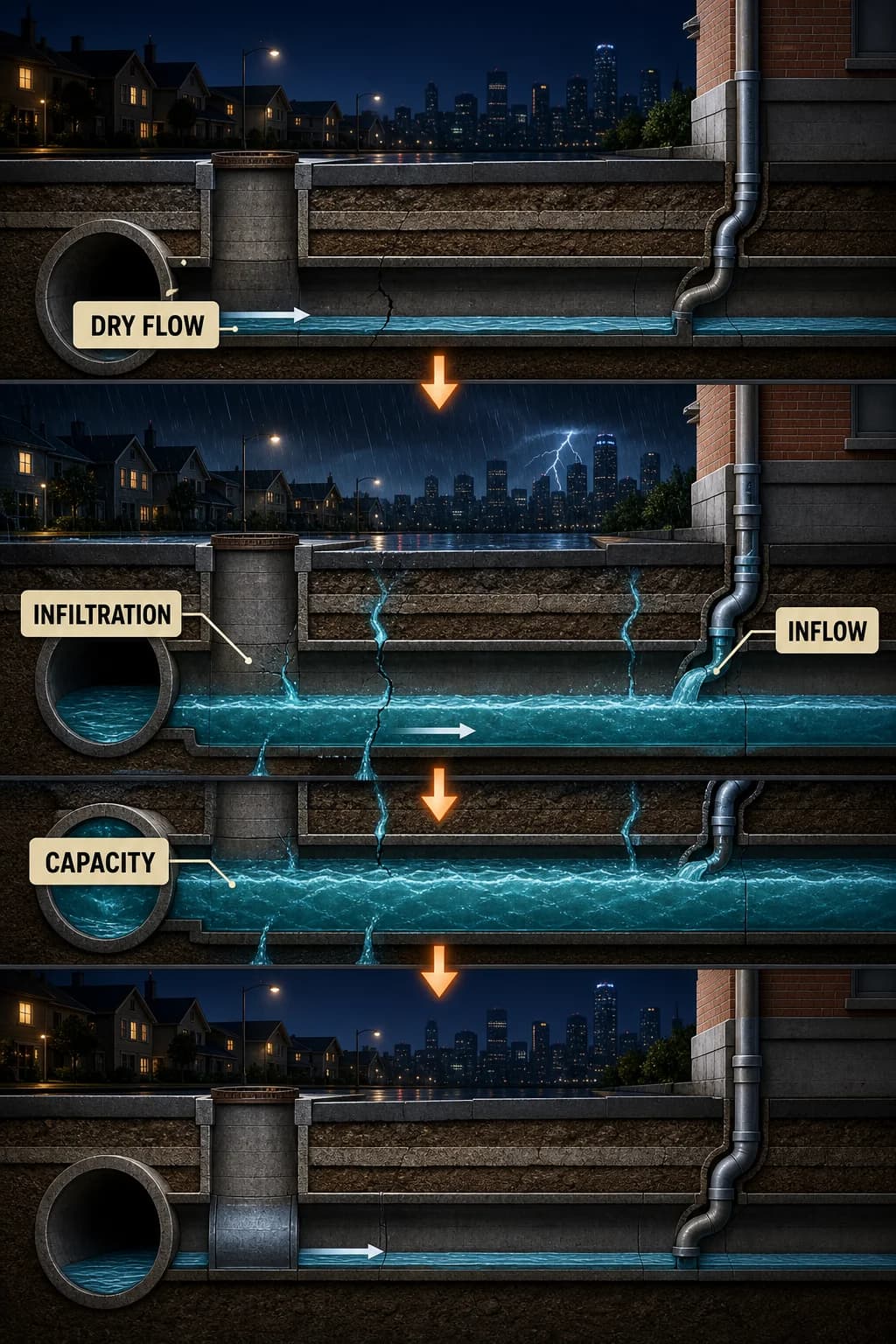
Sanitary sewers are intended to carry wastewater, but groundwater can enter through cracked pipes and joints, while roof drains or other improper connections can send stormwater into the system. This infiltration and inflow may be small in dry weather yet overwhelm pipes, lift stations, and treatment during storms.
Grease, wipes, roots, sediment, corrosion, and structural damage create additional restrictions. Utilities inspect manholes and pipes, use cameras or smoke testing, monitor levels and flows, clean deposits, and repair defects. A sewer's hidden performance depends as much on keeping unwanted water and obstructions out as on providing enough nominal pipe size.
The same sewer is compared in dry weather and a storm: cracks and an improper roof connection add cyan inflow until the pipe nears capacity, while inspection and repair isolate the extra paths.
Key takeaways
Gravity sewers convert elevation into continuous transport
Lift stations reset the route where terrain prevents further descent
Unwanted stormwater and groundwater can consume sewer capacity
Check your understanding
Why do gravity sewer pipes need a designed slope?
The gradient moves wastewater toward discharge while supporting adequate hydraulic performance.
What happens after a lift station raises wastewater?
It may enter a higher force-main outlet from which gravity flow can resume.
How can a storm overload a sanitary sewer?
Groundwater and stormwater can enter through defects or improper connections and use up its capacity.
Sources
These references were used to check the important factual claims in this edition.