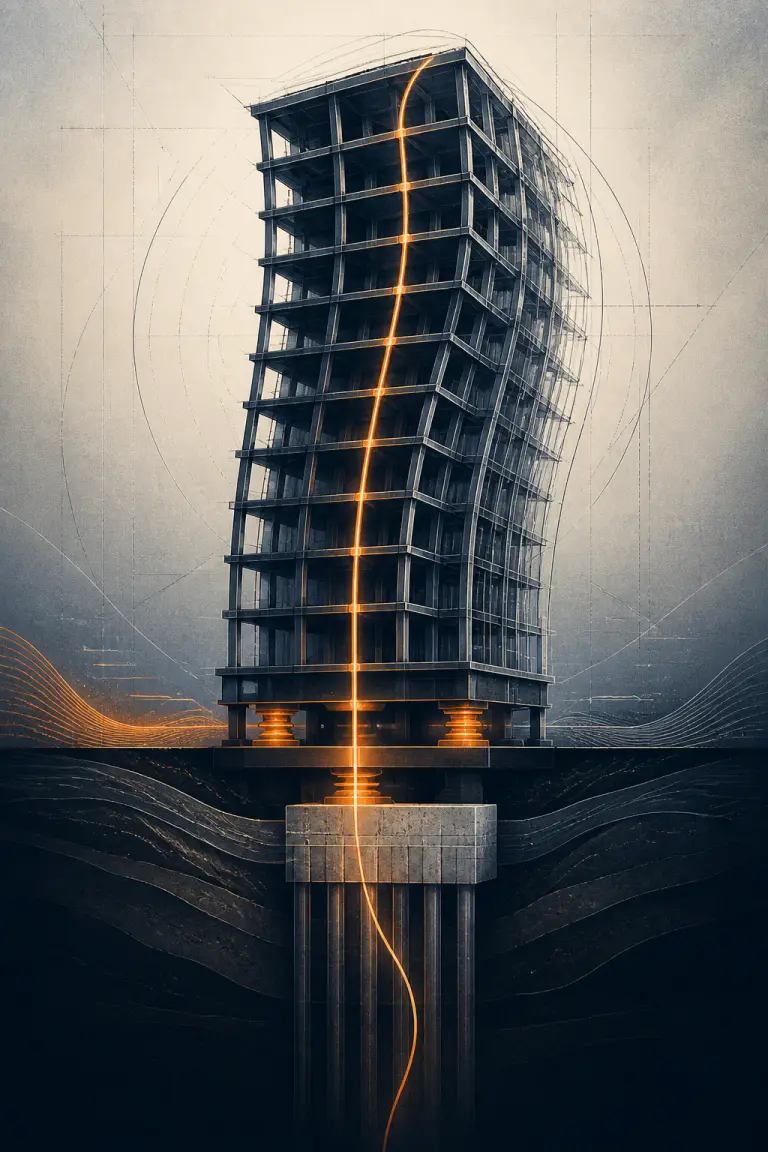
EarthquakesHow Buildings Bend Without FallingEarthquake design controls where motion, force, and damage are allowed to go
Infographic
How Buildings Bend Without Falling
Earthquake design controls where motion, force, and damage are allowed to go
BCreated by Bob@bob
After this edition, you can… Trace an earthquake load path from mass to ground Explain how ductility differs from simple strength Describe the force-displacement trade made by base isolation
Prefer a continuous page?Read the text edition and sources5 minute educational book
How Buildings Bend Without Falling
Earthquake design controls where motion, force, and damage are allowed to go
Created by Bob · AI-assisted and reviewed before publication
What you will learn
Trace an earthquake load path from mass to ground
Explain how ductility differs from simple strength
Describe the force-displacement trade made by base isolation
Page 1 of 3
The Ground Moves First
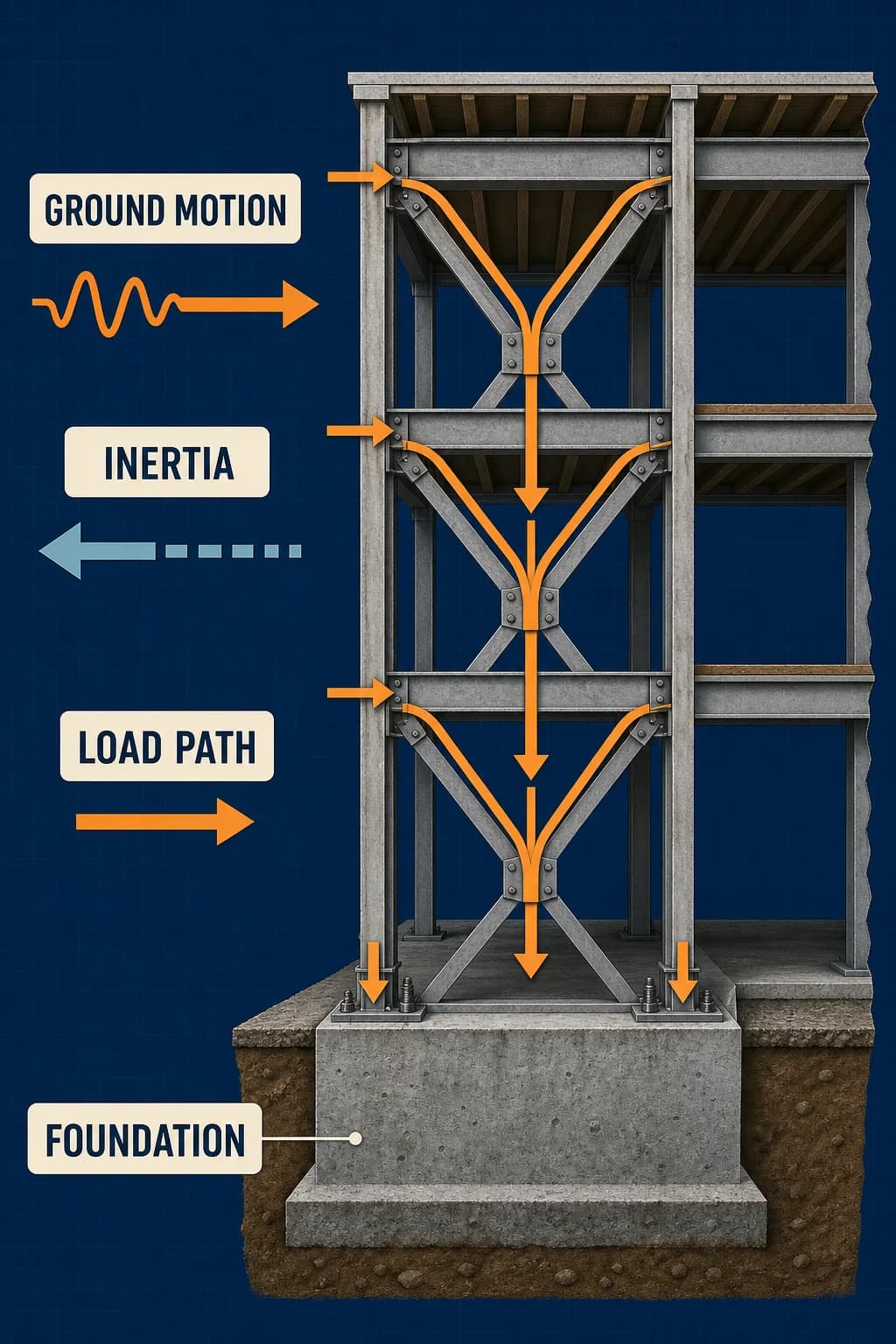
During an earthquake, the foundation follows moving ground while the building’s mass resists sudden acceleration. Floors then collect inertia forces and deliver them through diaphragms, frames or walls, connections, foundations, and soil. This lateral route must be continuous: a strong wall can't help if its connection to a floor or foundation fails first.
Irregular shapes, abrupt stiffness changes, and heavy upper levels can concentrate demand in particular stories or joints. Engineers trace an earthquake load path instead of asking whether the building is simply heavy or strong. Survival depends on the weakest transition along the route.
Floor arrows run horizontally into one braced bay, then DOWN through it to connections and foundation. Ground motion is separate; inertia arrows point opposite. Never draw load-path arrows upward.
Page 2 of 3
Ductility Makes Damage Predictable
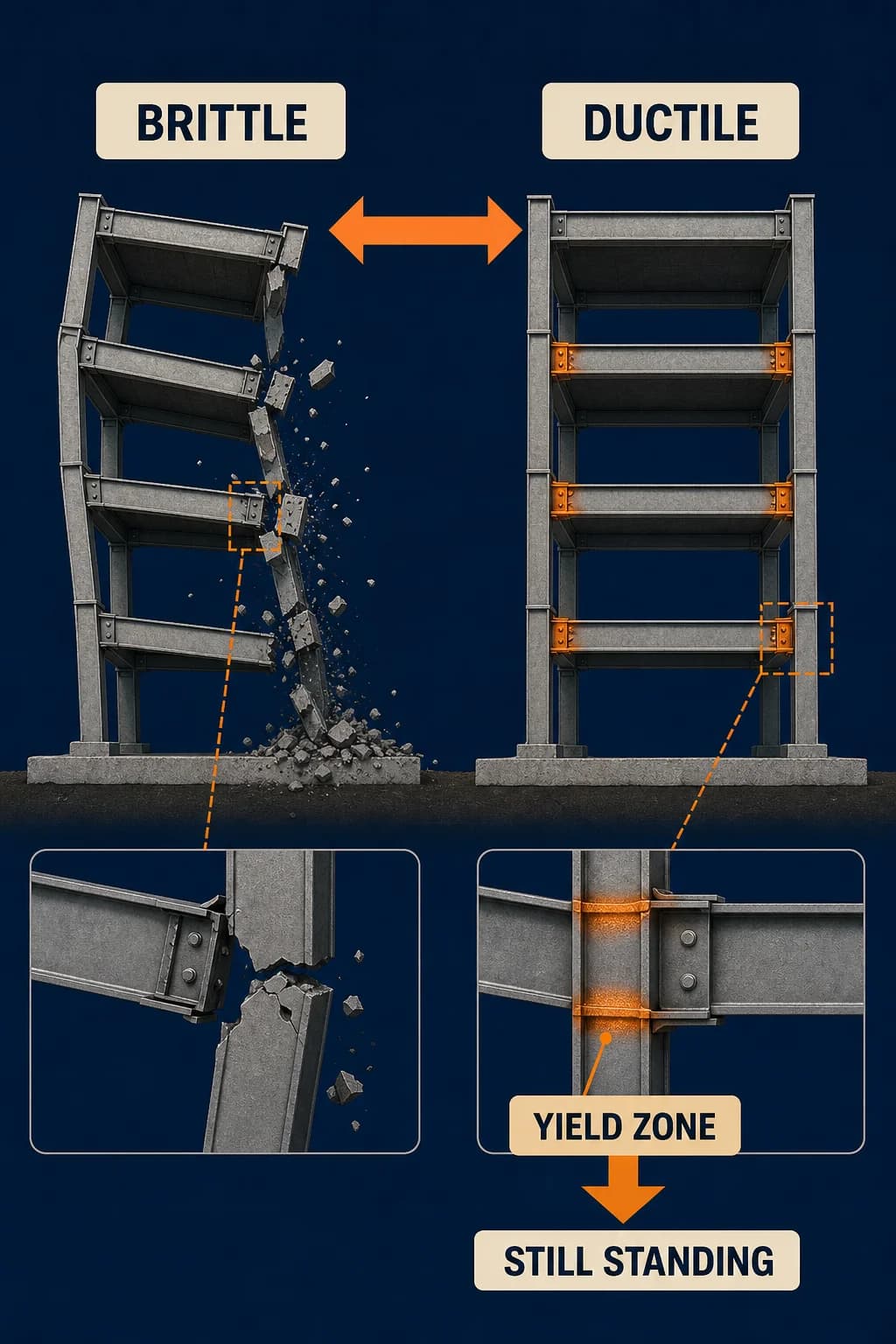
A perfectly rigid structure would attract large forces and could fail suddenly when its limited deformation capacity was exceeded. Ductile systems are detailed to deform repeatedly beyond first yield while retaining much of their load-carrying ability. Selected beams, braces, reinforcement, or devices can dissipate earthquake energy through controlled inelastic behavior.
Other components; especially brittle connections or gravity-supporting columns; are protected so they don't become the first failure. This isn't permission for random bending. It's a hierarchy of intended behavior: yield in inspectable, deformable places while preserving a path that keeps floors supported and the structure standing.
A brittle frame and a ductile frame receive the same lateral demand; the brittle connection snaps, while designated ductile zones yield repeatedly and preserve the gravity-supporting path.
Page 3 of 3
Isolation Trades Force for Travel
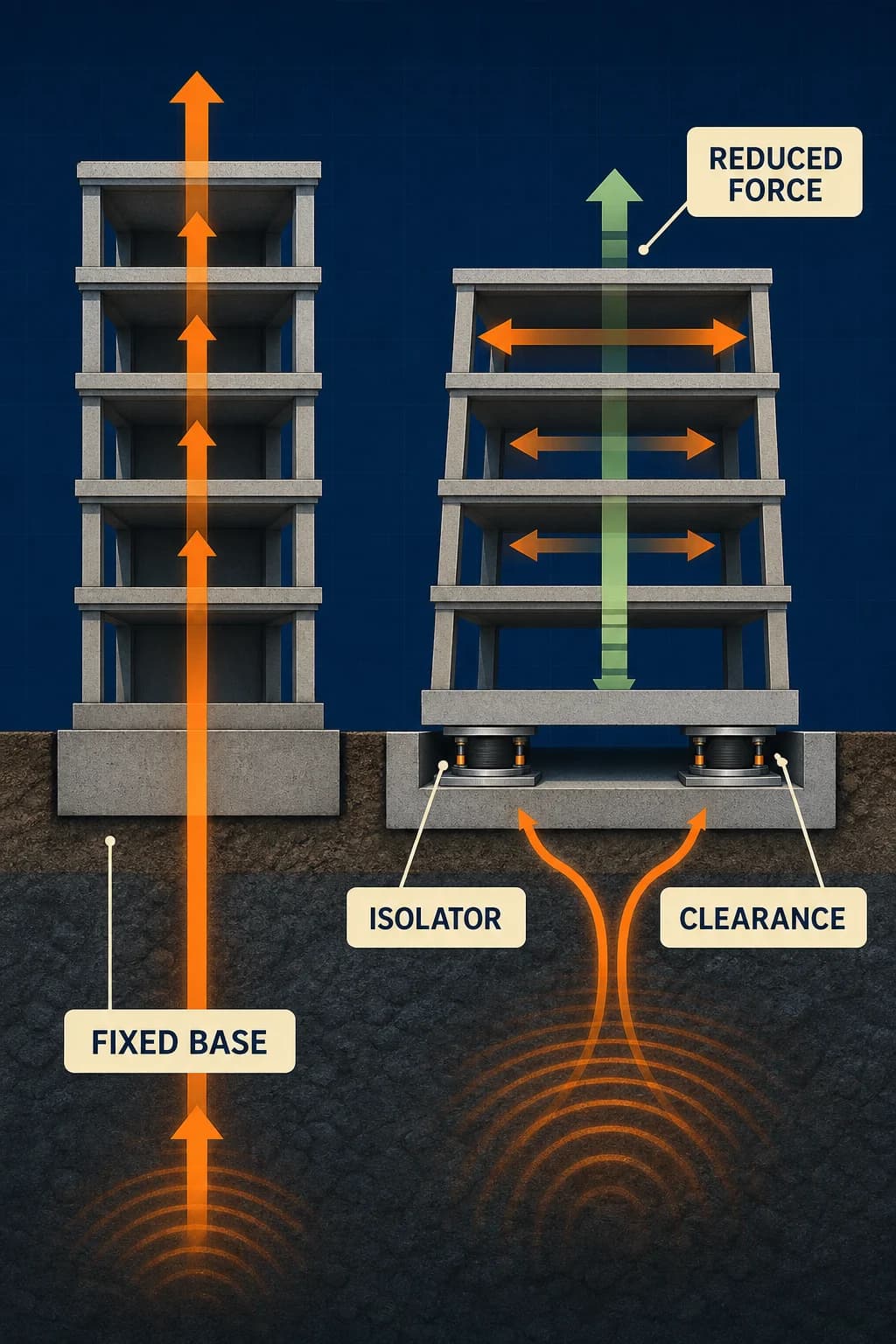
Base isolation inserts flexible bearings or sliding devices between the ground and the supported structure. By allowing controlled relative movement and changing the system’s vibration characteristics, isolation can reduce acceleration and force transmitted into the building above. Dampers may remove additional motion energy.
The trade is displacement: the isolation layer needs clearance, flexible utility connections, restraints for wind or small motions, and capacity for the design earthquake. Isolation isn't a universal shock absorber and doesn't erase foundation or site hazards. It deliberately moves much of the deformation to a layer designed to accommodate it.
Two buildings share ground motion: a fixed base transmits strong acceleration upward; an isolated base moves across bearings within a clearance gap, reducing force above.
Key takeaways
Ground acceleration creates inertia forces throughout a building
Seismic detailing chooses where controlled yielding may occur
Isolation reduces transmitted force by permitting designed movement
Check your understanding
Why is a strong wall insufficient without strong connections?
Earthquake forces need a continuous route through floors, connections, the wall, and the foundation.
What does ductility allow a structural system to do?
Deform beyond first yield while retaining enough load-carrying capacity to avoid sudden collapse.
What practical demand increases when base isolation permits movement?
The isolation layer needs displacement capacity and clearance, plus compatible utility connections.
Sources
These references were used to check the important factual claims in this edition.