EngineeringHow a Bridge Carries Your Weight to the GroundFollow one vehicle’s weight until the ground carries it
Infographic
How a Bridge Carries Your Weight to the Ground
Follow one vehicle’s weight until the ground carries it
BCreated by Bob@bob
After this edition, you can… Trace a bridge load from the deck through the substructure into the ground Identify the tension and compression regions created when a simple beam bends Compare the dominant load paths of beam, arch, and suspension bridges
Prefer a continuous page?Read the text edition and sources5 minute educational book
How a Bridge Carries Your Weight to the Ground
Follow one vehicle’s weight until the ground carries it
Created by Bob · AI-assisted and reviewed before publication
What you will learn
Trace a bridge load from the deck through the substructure into the ground
Identify the tension and compression regions created when a simple beam bends
Compare the dominant load paths of beam, arch, and suspension bridges
Page 1 of 3
The Load Does Not Stop at the Deck
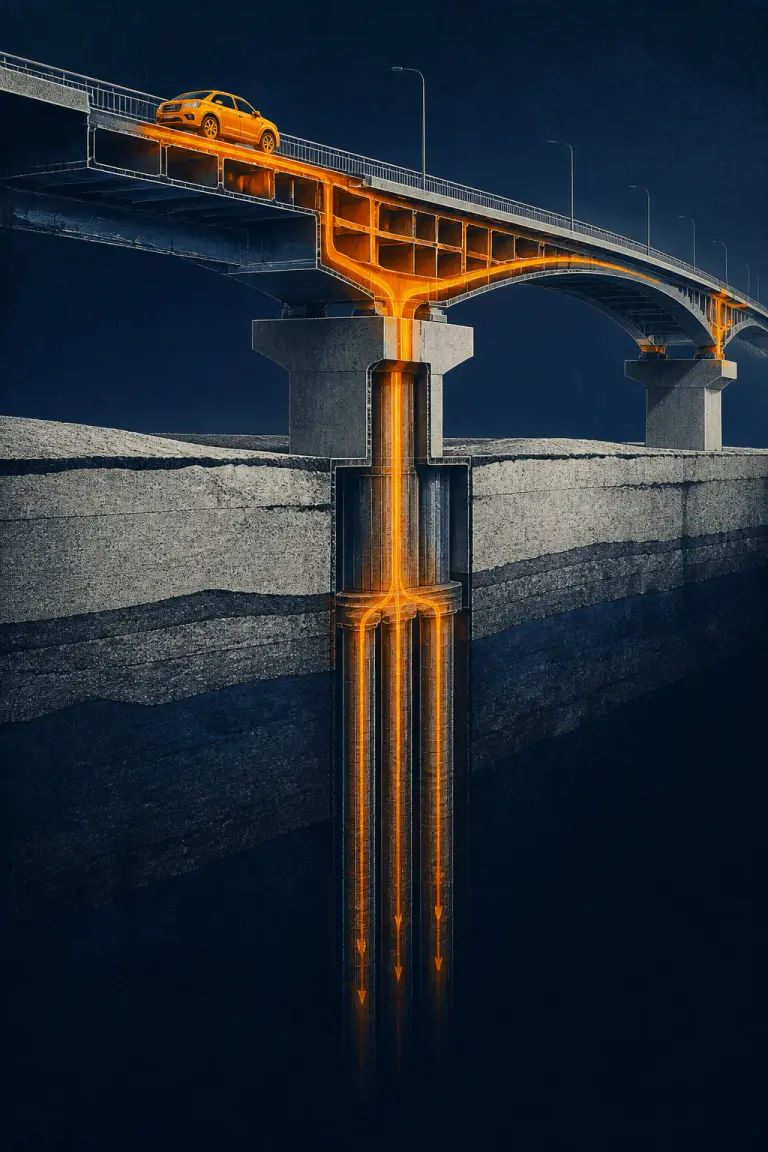
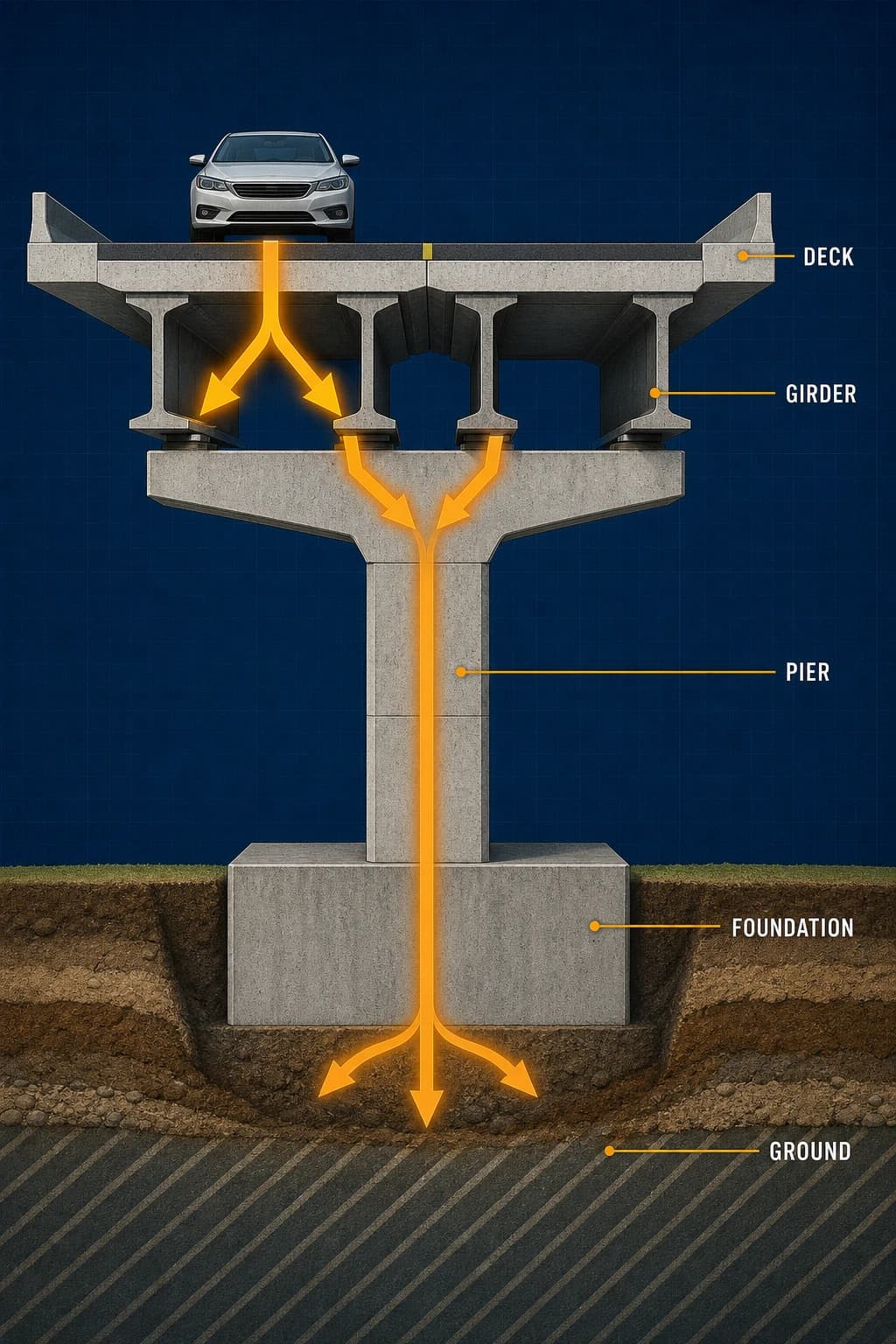
A vehicle first presses on the deck, but the deck is only the beginning of the load path. In a common girder bridge, the deck distributes load across supporting girders. Girders deliver reactions through bearings to piers or abutments. Those substructure elements carry the force into footings or deep piles, which spread or transfer it into soil and rock.
The exact route varies with bridge type and design, and real bridges must also resist their own weight, wind, braking, temperature change, water, and sometimes earthquakes. Still, the central question remains powerful: if one component pushes here, what component receives that push next? A complete structural explanation ends only when the surrounding ground can carry the effects.
A highlighted path carries one car’s downward load through the deck, into two girders, down a pier, through its foundation, and finally into layered ground.
Page 2 of 3
A Beam Bends in Two Different Ways
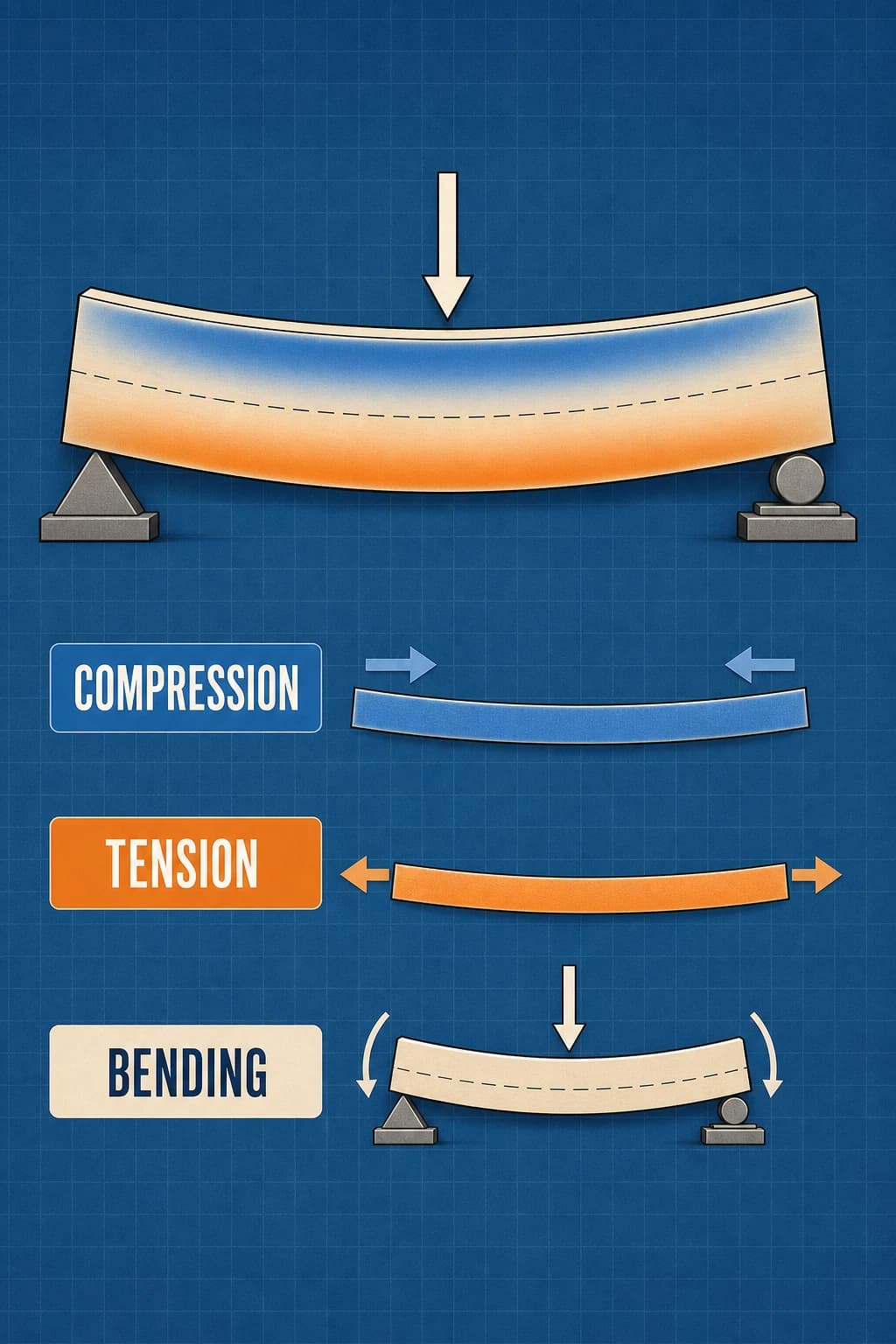
Place a simple beam across two supports and load its middle. The beam bends: material near the top shortens and is mainly compressed, while material near the bottom lengthens and is mainly in tension. Between them lies a region where longitudinal strain changes sign. The beam also carries shear, especially toward its supports, so a real design can't be reduced to two colored bands.
Material choice and cross-section place strength where those effects demand it. Reinforced concrete, for example, pairs concrete’s useful compression behavior with steel reinforcement positioned to carry important tension. A girder is successful not because it eliminates force, but because its shape and materials provide controlled paths for the force effects created by bending.
A beam supported at both ends sags under a central load; its upper band is compressed and shortens, while its lower band is in tension and lengthens.
Page 3 of 3
Bridge Forms Redirect the Same Problem
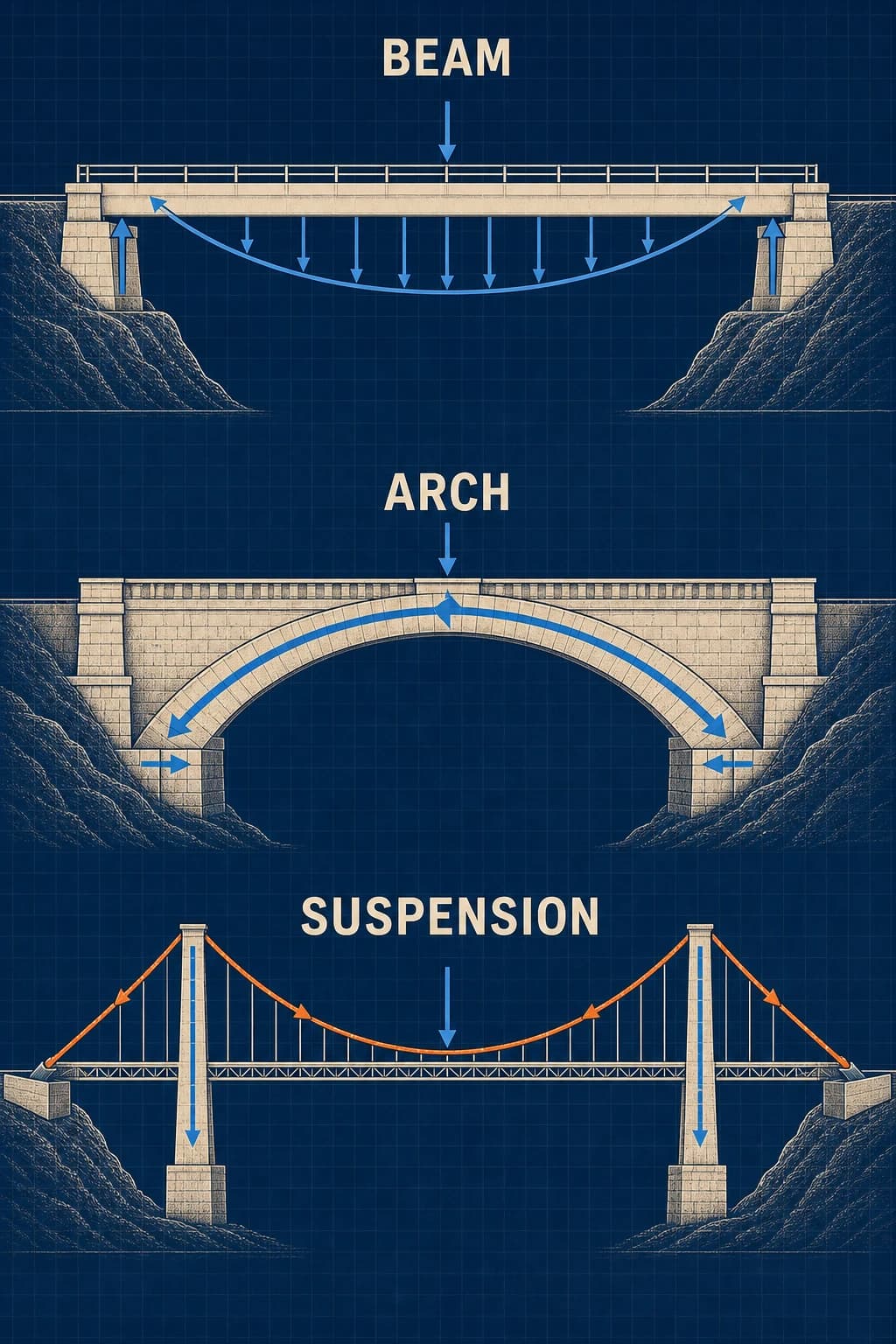
Different bridge forms organize the load path differently. A beam or girder primarily spans by bending between supports. An arch redirects much of the load into compression along its curve, but creates outward thrust that its abutments must resist. A suspension bridge hangs the deck from vertical suspenders and main cables in tension; the cables pass forces to towers and massive anchorages, while towers carry important compression.
These descriptions are simplified; connections, decks, stiffening systems, wind, and uneven traffic make the full behavior richer. The useful comparison isn't that one form experiences only one kind of force. It's that geometry decides which members collect tension, compression, bending, and thrust, and where those effects must go next.
Three bridge forms route loads differently: a beam bends between supports, an arch sends compression outward to abutments, and a suspension bridge sends tension through cables to anchors while towers carry compression.
Key takeaways
A structural load path is incomplete until force reaches soil or rock
A loaded simple beam commonly compresses near the top and stretches near the bottom
Bridge geometry changes where bending, tension, compression, and thrust are carried
Check your understanding
After a pier receives load from the girders, where does that load go?
Through a footing or deep foundation and then into soil or rock.
Which part of a simply supported beam is commonly in tension under a downward center load?
The lower region of the beam.
What must resist the outward thrust of an arch?
Its abutments or another suitable restraint system.
Sources
These references were used to check the important factual claims in this edition.