BicyclesHow Steering Keeps a Bicycle UprightTiny turns move the support path back beneath a falling center of mass
Infographic
How Steering Keeps a Bicycle Upright
Tiny turns move the support path back beneath a falling center of mass
BCreated by Bob@bob
After this edition, you can… Explain why rolling makes steering an effective balance input Trace a steer-toward-the-fall correction Reject gyroscopic action as a complete or necessary explanation
Prefer a continuous page?Read the text edition and sources5 minute educational book
How Steering Keeps a Bicycle Upright
Tiny turns move the support path back beneath a falling center of mass
Created by Bob · AI-assisted and reviewed before publication
What you will learn
Explain why rolling makes steering an effective balance input
Trace a steer-toward-the-fall correction
Reject gyroscopic action as a complete or necessary explanation
Page 1 of 3
Standing Still Leaves No Fast Correction
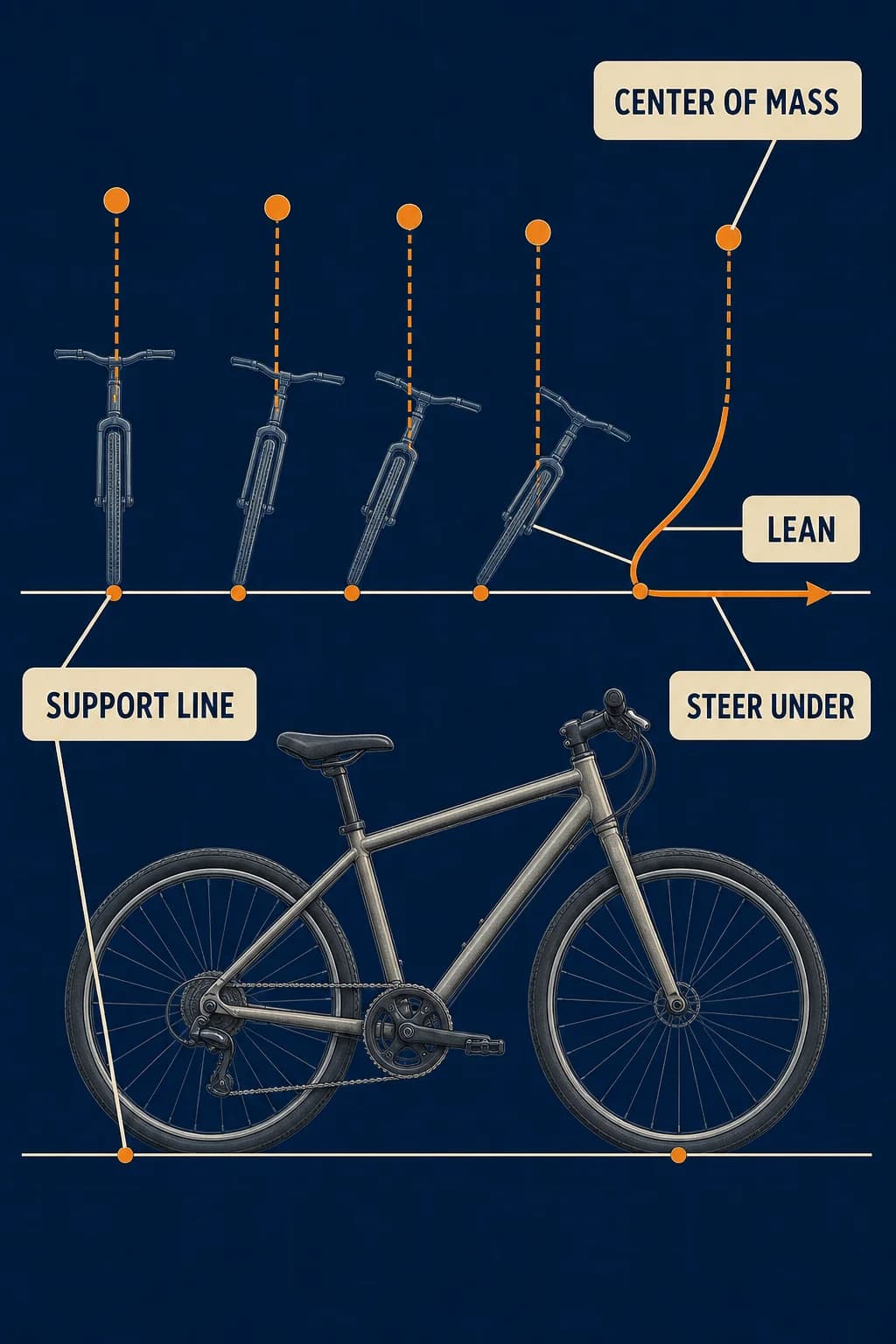
A stationary bicycle touches the ground along narrow tire patches. If its combined center of mass moves to one side of that support line, gravity creates a growing roll instead of a restoring push. A rider can shift body mass or turn the handlebars, but at zero speed steering doesn't quickly move the contact path beneath the falling mass.
Once rolling, a small steer changes where the wheels travel. That gives both rider and bicycle a rapid way to reposition support. Forward motion doesn't abolish gravity; it makes steering an effective control input before the lean becomes too large.
Side-view pedal bicycles only. Draw a horizontal ground line through both tire contacts; the SUPPORT LINE pointer touches this baseline, never the fork or frame. A high mass dot falls beyond it; then a curved path steers beneath the dot. No motorcycle parts.
Page 2 of 3
Steer Toward the Fall
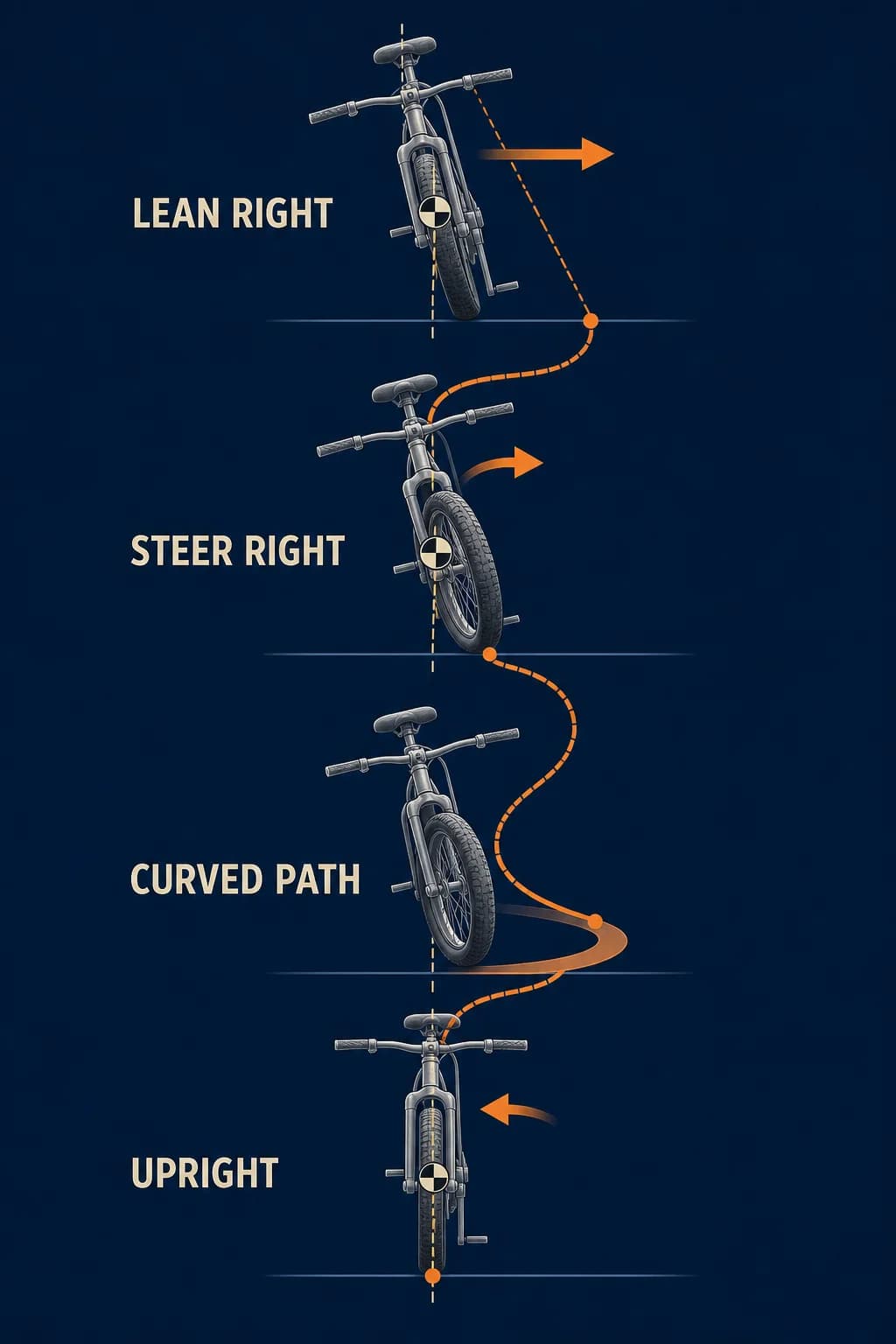
When a bicycle leans right, steering right curves the tire path rightward. The required inward acceleration and contact forces can reduce the mismatch between the path and the leaning mass, bringing the wheels back under the system. Riders perform a continuous feedback loop: sense lean and roll rate, apply a small steering torque, observe the response, and correct again.
To initiate a deliberate left turn, a rider first makes a brief countersteer that creates left lean, then steers into the resulting curve. Balance and turning are coupled; the handlebars aren't just for pointing a previously stable machine.
A time sequence shows a rightward lean, a small steer toward that fall, the curved tire path moving under the center of mass, and the bicycle returning toward upright as feedback repeats.
Page 3 of 3
There Is No Single Magic Effect
Spinning wheels generate gyroscopic effects, and ordinary steering geometry often helps a moving bicycle steer in response to lean. Both can contribute to passive self-stability over some speed range. Experiments have nevertheless produced riderless bicycles that self-stabilize with wheel angular momentum canceled and with negative trail, showing that neither gyroscopic action nor positive caster-like trail is individually necessary.
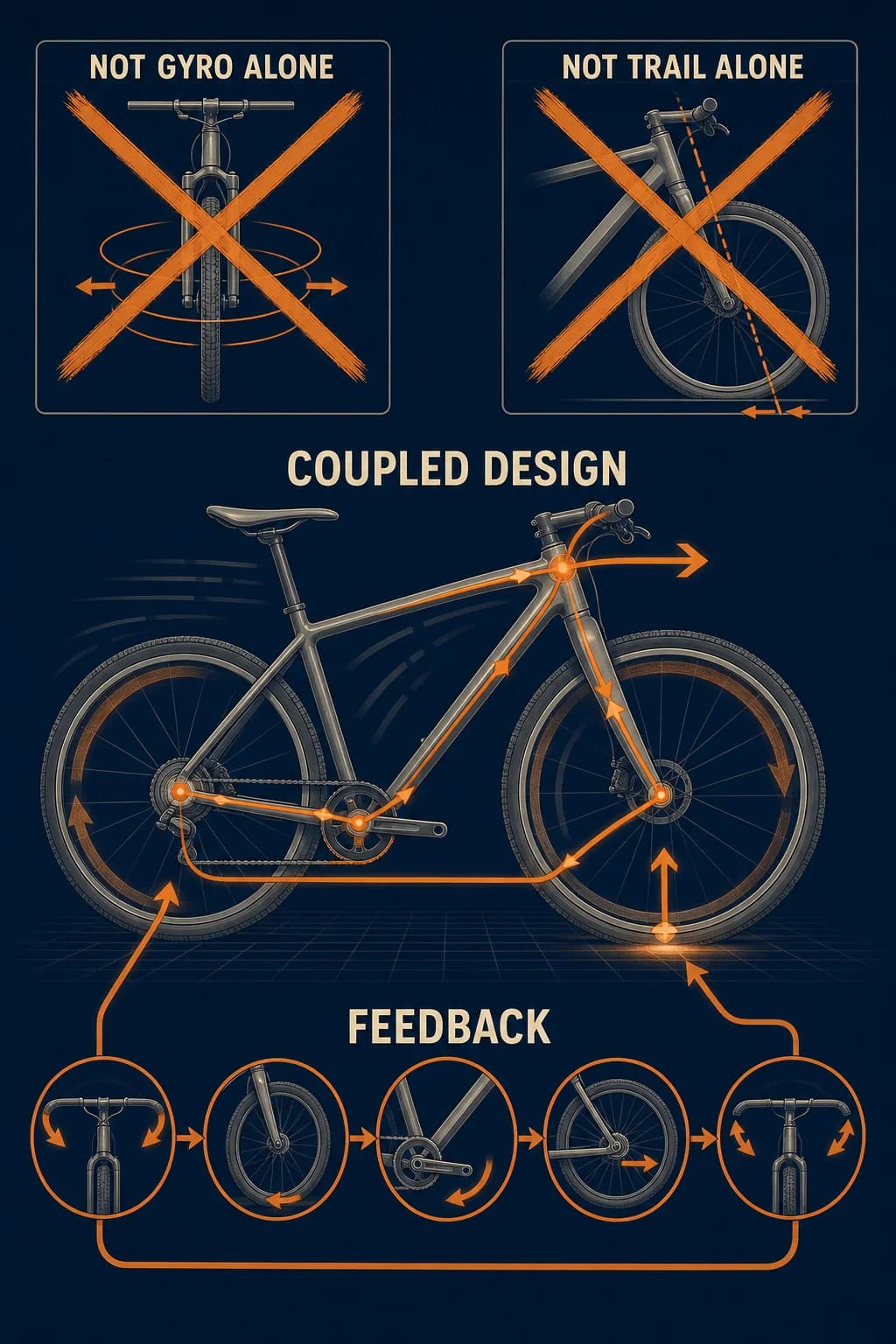
Mass distribution, steering-axis tilt, trail, wheel inertia, tire behavior, speed, and rider control interact. The honest explanation is a coupled steering-and-leaning system with several possible stabilizing designs; not just a pair of gyroscopes refusing to fall.
Pedal bicycles only; no motorcycles, engines, or fuel tanks. Cross out gyro-alone and trail-alone panels; combine mass, steer geometry, wheel effects, speed, and rider feedback below.
Key takeaways
A rolling bicycle can move its support path beneath its mass
Balance corrections and deliberate turns both couple steering with lean
Several design variables and rider feedback can produce stability
Check your understanding
Why is balancing harder at zero speed?
Steering can't quickly move the tire contact path beneath a developing lean.
Which way should the wheel briefly steer to correct a rightward fall?
Toward the right, moving the path back beneath the leaning mass.
What did the counter-rotating-wheel experiment demonstrate?
A bicycle can self-stabilize even when ordinary wheel gyroscopic angular momentum is canceled.
Sources
These references were used to check the important factual claims in this edition.