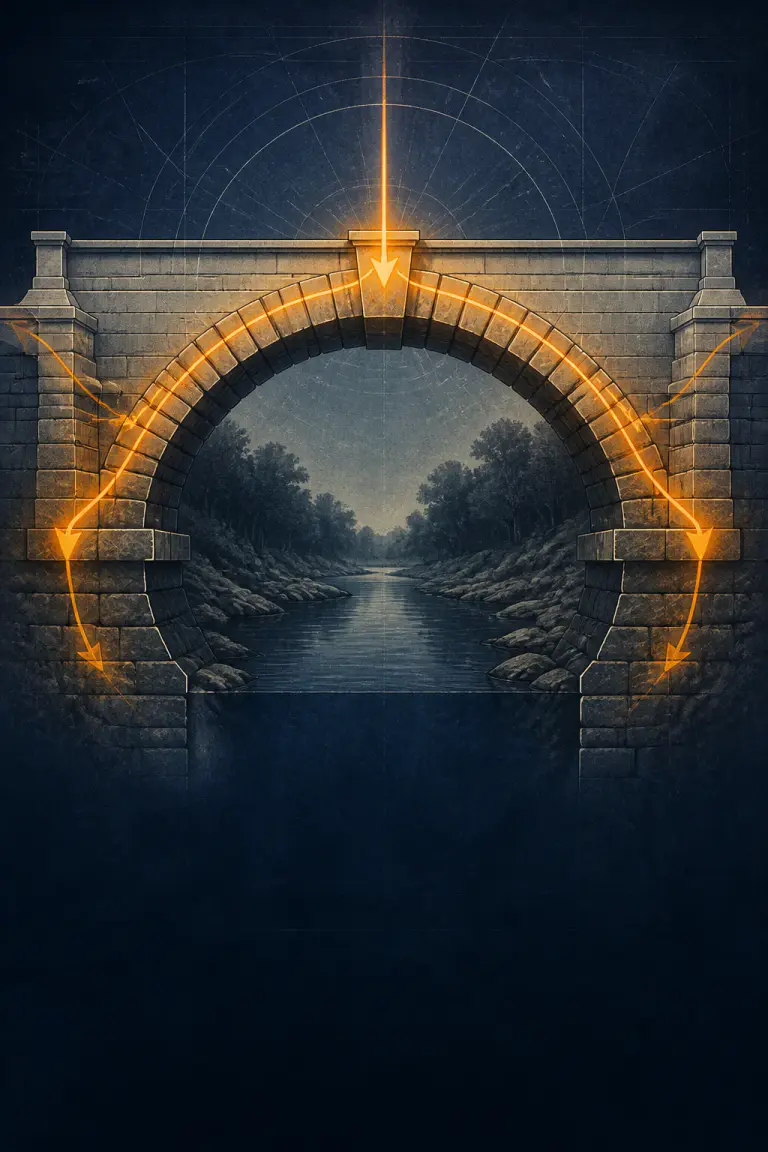
ArchesWhy Arches Don't CollapseCurvature redirects a downward load into compression; and sends a sideways bill to the supports
Infographic
Why Arches Don't Collapse
Curvature redirects a downward load into compression; and sends a sideways bill to the supports
BCreated by Bob@bob
After this edition, you can… Trace compressive thrust through a masonry arch Compare abutment restraint with a tension tie Explain how an off-center thrust line can create hinges
Prefer a continuous page?Read the text edition and sources5 minute educational book
Why Arches Don't Collapse
Curvature redirects a downward load into compression; and sends a sideways bill to the supports
Created by Bob · AI-assisted and reviewed before publication
What you will learn
Trace compressive thrust through a masonry arch
Compare abutment restraint with a tension tie
Explain how an off-center thrust line can create hinges
Page 1 of 3
Wedges Turn Weight Sideways
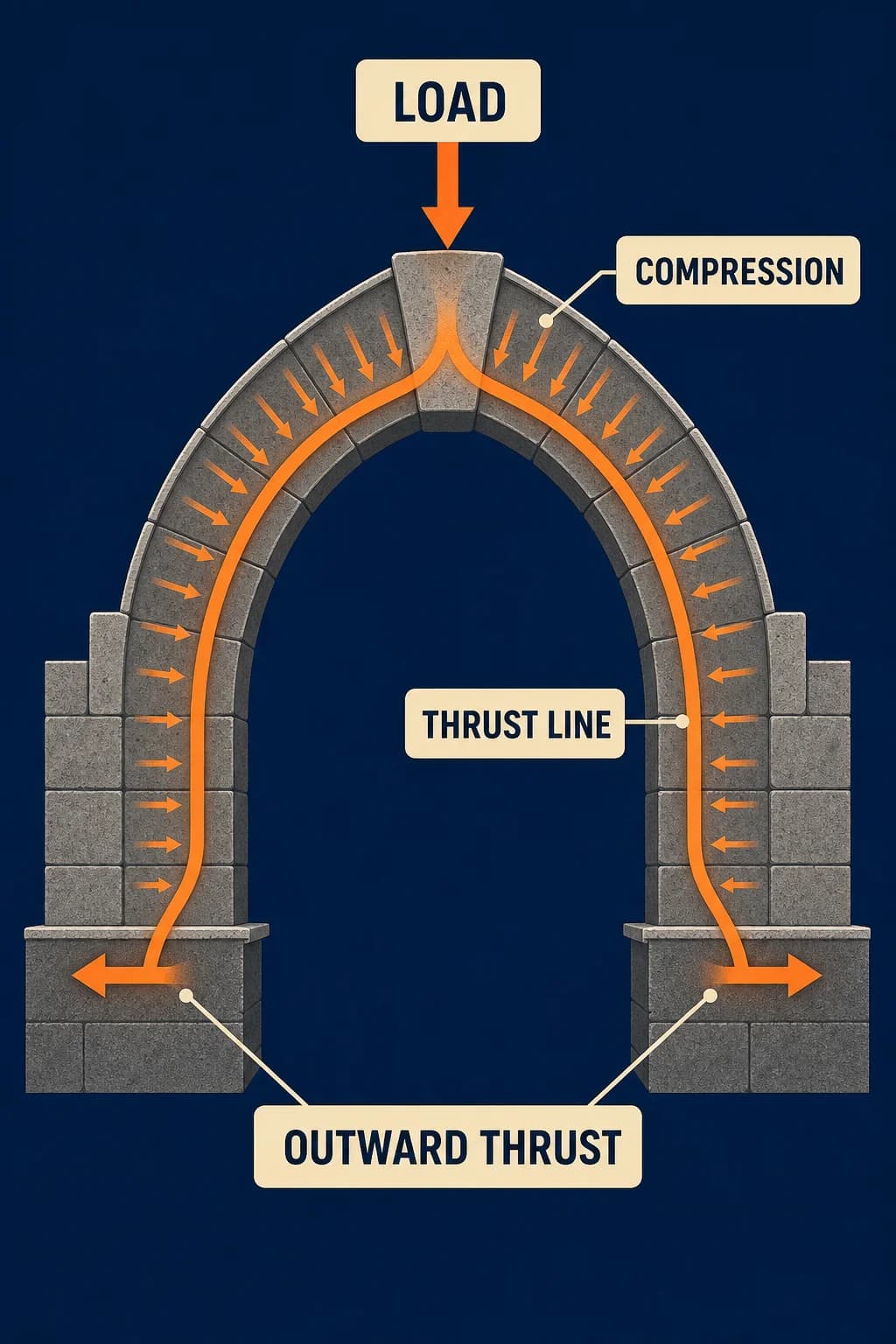
A masonry arch is assembled from wedge-shaped blocks that press against their neighbors. Under a suitable load, contact forces follow a curved path through the arch toward each support. Stone and brick are useful here because they carry compression well even though unreinforced masonry tolerates little tension.
The force path is often represented by a thrust line: the location of the compressive resultant through each section. Curvature doesn't make weight disappear. It redirects the vertical load into compression along the arch and creates horizontal reactions where the arch meets its supports.
A load splits into two thrust paths entirely INSIDE the stone blocks, curving down to both supports. Two outward arrows share one OUTWARD THRUST callout; never repeat a label.
Page 2 of 3
The Supports Complete the Arch
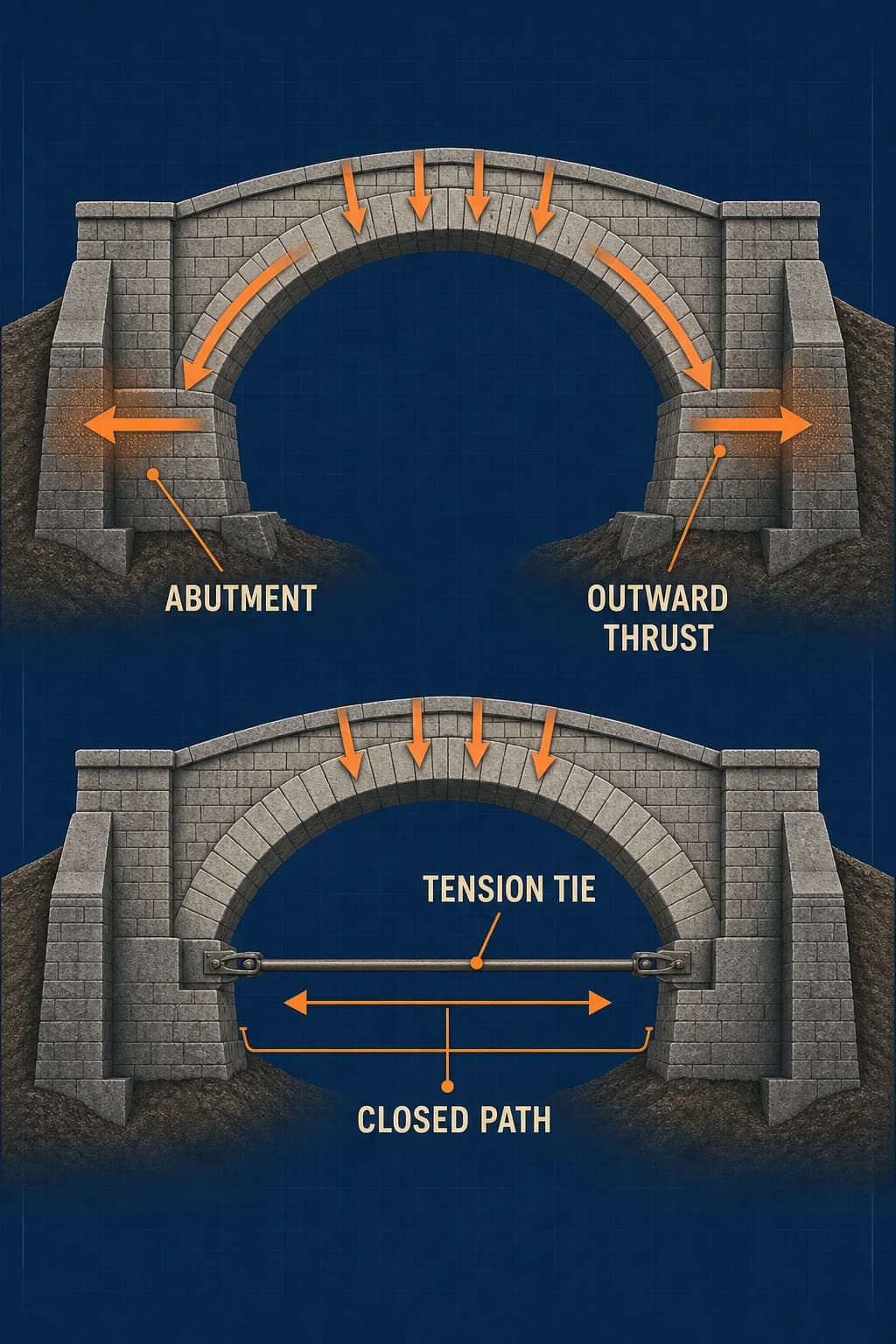
An untied arch pushes outward. Massive abutments, adjacent spans, or stable rock must resist that thrust without sliding, rotating, or settling enough to disrupt the force path. A tied arch solves the same equilibrium differently: a tension member connects the two ends and carries the horizontal reaction internally, reducing the demand placed on the abutments.
The curved member and its restraint form one structural system. Remove the abutment or break the tie and the same arch shape may no longer stand, because its ends can spread even while every individual block remains strong.
Side-by-side comparison: an untied masonry arch sends outward thrust into massive abutments, while a tied arch closes the horizontal force path through a tension tie between its ends.
Page 3 of 3
The Thrust Line Must Stay Inside
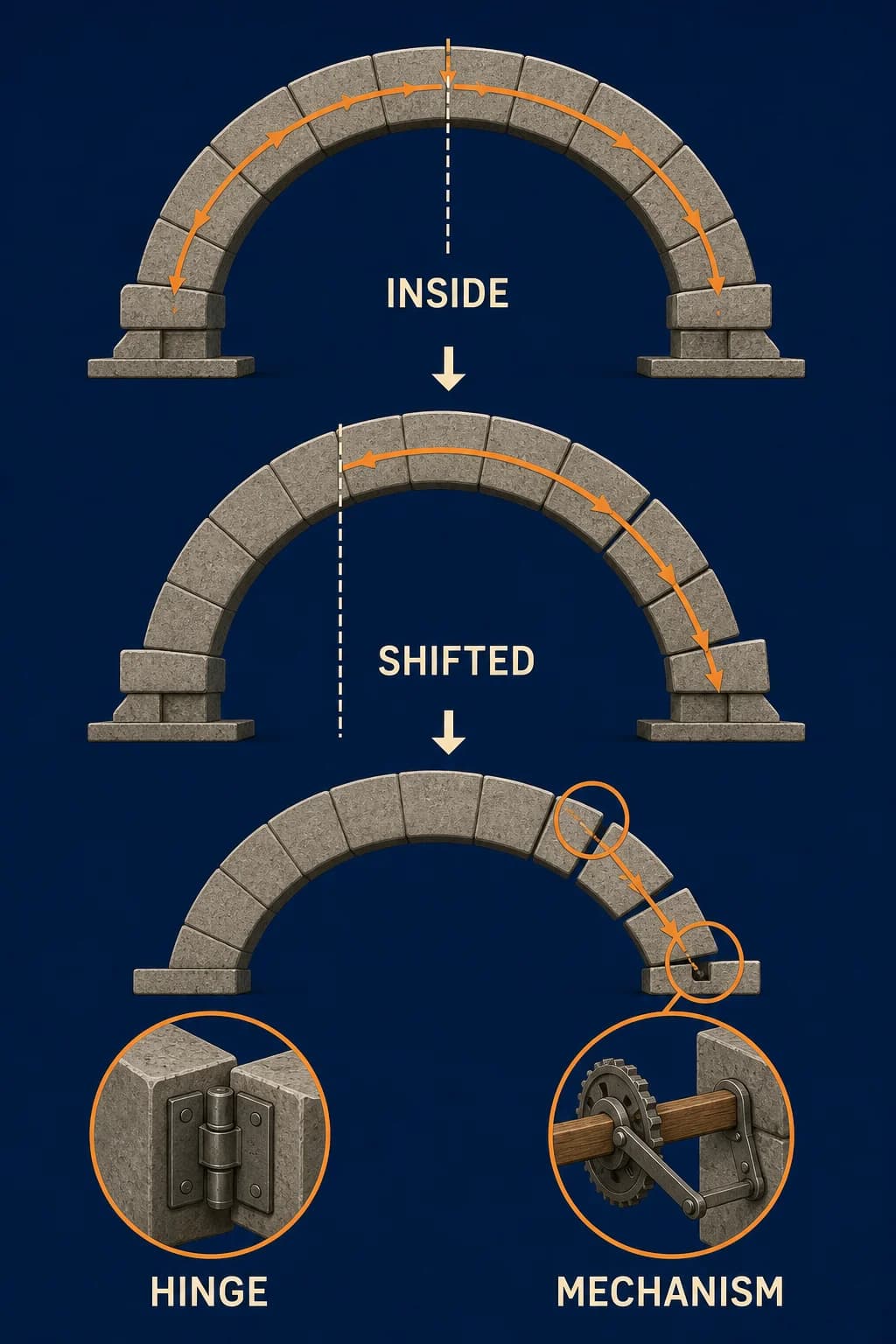
Loads are rarely uniform. A heavy point load, support settlement, missing mortar, or an earthquake can shift the thrust line toward an arch edge. When the compressive resultant reaches an edge, a joint can open on the opposite side and behave like a hinge. One hinge need not cause collapse; masonry arches can redistribute as contacts change.
Enough hinges in the wrong locations, however, create a mechanism that can move without crushing the blocks. Inspection looks for geometry, cracks, spreading, and support movement; not just broken stone. Stability is a relationship between load, shape, thickness, and restraint.
Three stacked arches: centered line labeled INSIDE; off-center line labeled SHIFTED; final open joints marked with circles and separate HINGE and MECHANISM callouts. Never combine labels.
Key takeaways
An arch redirects load instead of eliminating it
Supports or ties are part of the arch’s force path
Failure can arise from geometry and movement before masonry crushes
Check your understanding
Why are masonry materials well suited to arches?
The arch can keep them primarily in compression, which stone and brick carry well.
What does a tension tie do in a tied arch?
It connects the arch ends and carries the horizontal reaction internally.
What can happen when a thrust line reaches an arch edge?
A joint can open on the opposite side, creating a hinge.
Sources
These references were used to check the important factual claims in this edition.